Anatomy of a Digital Strategy

The strategy is the starting point of the digital transformation journey. Digital leaders have a sound strategy. Strategy is repeatedly cited in digital transformation papers, books, media coverage, and this blog. Strategy, strategy, and more strategy.

So, how does a digital strategy look like?

One important clarification before going further, this post is not a comprehensive strategic thinking methodology to develop a digital transformation strategy. For those beginning the digital journey, the framework provides a practical guide to get started. This post proposes a structure to organize ideas, priorities, initiatives, and projects to describe the digital future and the route to get there, in a logical and understandable format.

Back to the strategy. The details will vary significantly depending on industry characteristics, competitive dynamics, starting maturity, the possibilities available to each company, and the ambition of the leadership team in charge. But experience points to a few common elements.

Structure of a Digital Strategy

Digital Vision

The digital vision describes as precisely and as simply as possible how business will be conducted after being transformed by technology.

Will the means of delivering value to customers change? Can the customer experience be thoroughly reinvented? Can a digitally enabled commercial model change the rules of an industry?

Fractional or pay-per-use, peer-to-peer platforms, anything-as-a-service, open-anything are the sort of models that give digital visions stamina and have a higher chance of putting the leaders behind the strategy in the offensive and the competitors on the back foot.

Not all business or sectors can be wholly reconfigured by technology, but many seem stagnant until a clever entrepreneur comes with a disruptive idea. Simply prescribing more use of technology, for marketing, process automation or old-school ecommerce (it’s almost 30 years old already!) will rarely make a digital strategy disruptive or even competitive enough to move the needle. Combined adoption of several technology innovations, aggressive investment in exceptionally strong capabilities and nimble execution may provide sustainable competitive advantage. Designing and successfully implementing a D2C model that complements the role of traditional channels without creating conflict may also it.

Summary: the digital vision must point to structural and significant changes to how business is conducted, por instance to novel approaches to engage with customers, create value or use assets, enabled by technology. Adopting more platforms, no matter how advanced, is an IT plan, not a digital vision.

Digital Aspiration

The digital vision translated into measurable ambitions: market busting pricing or value creation structures, disruptive growth or market penetration targets, massively reconfigured financial ratios, [probably resulting in] improvements in EBITDA, etc. There are two references to develop the targets: one is bottoms-up, coming from the business cases supporting specific initiatives and investments, the other is top-down: the aggregate jump in financial performance compared with the past, the industry, or benchmarked against digital leaders.

The digital aspiration converts the vision in quantifiable impact, provides targets to align expectations, and supports the case for investment and change. The targets in the digital aspiration should be one of the first exercises of the “single source of truth” practiced by digital leaders. Tweaks and recalibrations are typical in a journey full of uncertainties and experimentations, but if the metrics or targets keep on changing, or different stakeholders look at different versions, it is time to reconsider if things are really going in the right direction.

It is beyond debate that digital leaders drive better results, here is where a leadership team must agree on the drivers that will turn investment and change in quantifiable impact.

Strategic Pillars

These are a few “themes” that support the vision and align the components of the strategy. Some are industry specific (streaming may a theme for media but not for other industries) but some (like customer experience and data-driven business) can be innovation vectors in many industries.

Identifying and adopting the pillars serves several useful purposes:

  • Build consensus on which are the key innovation and value-creation drivers
  • Provide a structure to align priorities, initiatives, technologies, capabilities and investments across teams and business units, and
  • Give the vision and strategy focus, stability, and credibility over time as priorities, initiatives and technologies evolve and shift

The pillars are one – if not the most – significant elements connecting the pieces of the digital strategy. They should be carefully picked and tightly aligned with the vision.

Initiatives and Technologies

These are the concrete plans, actions, and investments to convert the vision in actions and tangible results. They should be described at a very high level in the digital strategy itself, leaving the details to stand alone plans or mission statements for the dedicated agile teams tasked with the execution. (More on this below.)

Some initiatives and technologies will span multiple pillars – in fact these are the more attractive plays because application of multiples technologies to the same business situations have a multiplicative effect in terms of innovation, and if properly executed and the underlying competencies perfected are very difficult to imitate.

An example: bundling industrial equipment “as-as-service” with auto-reordered supplies based on historic consumption rates and real-time customer site inventory spans customer experience, data-driven business and process automation as pillars, and will require integrating remote sensors, advanced analytics, IoT and a highly autonomous B2B e-commerce platform.

The proposed format of compact summaries in each intersection of pillars, initiatives and technologies promotes strategic alignment and consistency. From this point commonly employed strategic planning methodologies like OGSM can be used to define and track measurable goals and actions across different projects, parts of the organization, etc. Organizations with robust strategic planning processes can leverage them.

Capabilities

The vision describes the future, the pillars the change/value drivers and the initiatives and technologies map actions and investments. The capabilities are the enablers.

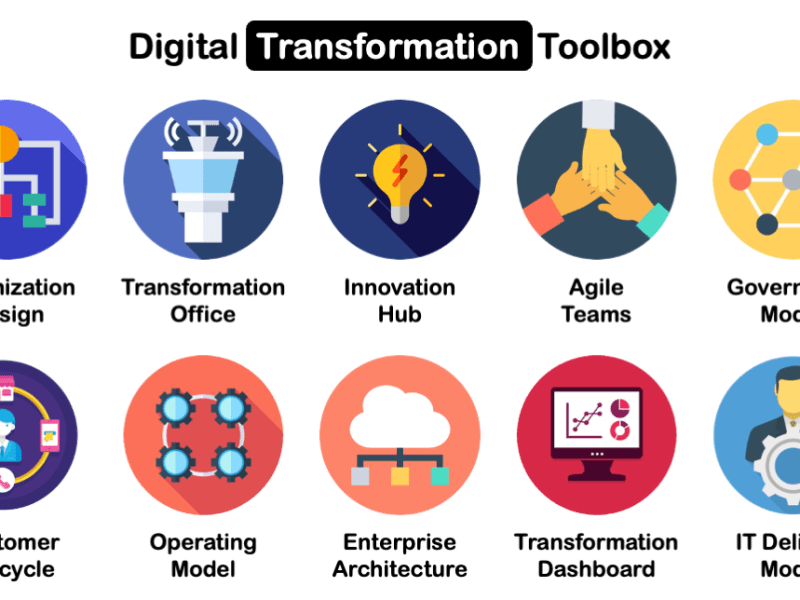
Most companies will have significant gaps to fill here. Some of are new organizational functions like the digital innovation hub and the transformation office, others are new skills like change management and Agile methodologies, and others are capacities like a modern operating model on the IT function, a modular digital architecture or good data governance. Each is described at more detail in the framework or specific articles.

The example in the picture is representative, but actual strategies can vary significantly. The capabilities section of the strategy will play a significant role in the design of the transformation strategy.

Goals and KPIs

Finally, the goals and KPIs are an execution-grade version of the targets in the digital aspiration, complemented with those from the business cases or initiative-specific.

I recommend using three types of KPIs. The execution indicators track that the basics are happening: people hired or reassigned, projects started, organizational changes implemented. These seem obvious, but when the to-do list is long this basic tracking anticipates roadblocks early on. The second set of transformation indicators track change. These are initiative-specific, but the common denominator is that they confirm that projects are churning along, and the innovative changes are being rolled-out. Then final set is the real thing: the digital KPIs track the actual impact: customers adopting new revenue models or better yet migrating from the competition, shift from human-assisted to fully digital order processing, etc. These are the ultimate proof of success!

Execution and transformation indicators are initiative or project-specific and probably transitory. Once enough execution and change momentum is achieved they can be discarded and focus shifted to the digital indicators that track the deep, disruptive vectors. Some metrics related to capabilities or culture (e.g. mid-level managers fully embracing digital and Agile by leading or originating ideas) may be kept in place for years to track transformation momentum beyond specific initiatives and projects.

A Word About Simplicity

The best digital strategies are surprisingly simple and compact. The structure pictured above can extend to two or three pages after initiatives, technologies, capabilities, and key metrics are broadly described and maybe some business or functional-unit level details are incorporated.
But if it cannot be kept at two or three pages, something is out of place. Details may have to be pushed down to specific action plans, or worse yet, the quantity of initiatives, projects or technologies be unrealistic. A complicated strategy or even a complicated presentation of the strategy can negatively impact communication, comprehension and alignment.

There are usually challenging actions, changes, and investments even behind beautifully simple and focused strategies. If it looks too complicated, it most likely is.


More on Strategy

The New Elements of Digital Transformation

The team behind The Digital Advantage: How Digital Leaders Outperform their Peers in Every Industry and The Nine Elements of Digital Transformation reflected on their influential research after surveying 1300 executives in more than 750 global organization.

Their earlier research on digital transformation identified two dimensions through which leading companies outperform their peers: digital capability and transformative leadership capability. They found that the elements of leadership capability have endured, but new elements of digital capability have emerged.

Particularly opportune is the addition of a digital architecture as a critical platform that enables nimble innovation. In my own experience, the lack if a well-designed and implemented architecture prevents the roll-out of initiatives large and small, consuming more technical resources and frustrating business partners.

The New Elements of Digital Transformation
By Didier Bonnet and George Westerman
MIT Sloan Management Review, November 2020

Fast Times: How Digital Winners Set Direction, Learn, and Adapt

In Fast Times, a team of McKinsey consultants share the recipe they apply to help their customers be first movers and win the digital race.

“[Fast Times] is for senior executives who are frustrated by the slow pace and limited return on investment (ROI) of their digital transformations, and are unsure what’s holding them back” in the word of the authors.

While not a detailed blueprint to design a Digital Transformation initiative, they cover critical imperatives to develop a Strategy, Capabilities, Adopt and Scale, and they cleverly do it answering provocative questions like “Are you clear about the which transformation model is best for your company?” or “Have you hired digital stars?”

They provide insightful tips on Speed, Scale, Talent and Culture. A must read for leaders already embarked in a digital journey or in need of a reset.

Fast Times: How Digital Winners Set Direction, Learn, and Adapt
by Arun Arora, Peter Dahlstrom, Klemens Hjartar, and Florian Wunderlich

Digital Transformation Is Not About Technology

Most business executives think – often reflected by who they bring to the room when you discuss the topic with a CEO – that Digital Transformation is about technology. It is not.

Certainly, top notch technology capabilities are a critical ingredient in all Digital Transformation success stories, but there is a lot more to it. This is the purpose and central theme of this blog: debunking the notion that technology is the most important factor in making a start-up or centuries old companies more competitive with digitally driven innovation, and expanding the field of view of executives to include the broader set ingredients that they will have to mix and match to lead their companies into the digital future.

Digital Before Transformation

Software is eating the world. In a now famous 2011 Wall Street Journal piece, technology entrepreneur and venture capitalist Marc Andreessen brilliantly made the case of why most companies were in the way of becoming software companies – across industries, from entertainment and banking to cars, retail and logistics.

“Six decades into the computer revolution, four decades since the invention of the microprocessor, and two decades into the rise of the modern Internet, all of the technology required to transform industries through software finally works and can be widely delivered at global scale” he wrote.

While banks still own branches, airlines fly planes and Amazon last year ordered 100,000 electric delivery trucks, technology is now in charge of engaging with customers, managing risk and fares, or deploying assets – and make companies winners or losers depending on how good their algorithms are.

Most of the underlying technology has been around for some time. But now its maturity, ubiquity, and affordability – and the ingenuity of the engineers, entrepreneurs and innovators deploying it – are giving it a dramatically more significant role in shaping business models and strategies. A Transformative role.

Time to Transform

Some industries and companies can be wholly reconfigured by technology – remember Blockbuster or Tower Records? – but not all. McKinsey puts is very well: “the number of companies that can operate as pure-play disrupters at global scale are few in number, and rarer still are ecosystem shapers that set de facto standards and gain command of the leverage created by hyperscaling digital platforms.”

But even in asset or activity-intense sectors that can’t be entirely switched to digital-only experiences, modern technology is driving major change, and visionary executives the world over have taken note and quietly started reshaping strategies, business models and organizations to exploit these new opportunities. They updated their leadership styles, cultures and platforms to design and deploy entirely new ways of doing things. They embarked in a Digital Transformation.

The Impact

Academics and consulting outfits have very carefully analyzed the advances in digitization and linked them with financial performance, and the relationship is undeniable.

A seminal two-year study by the MIT Sloan School of Management analyzed more than 400 large firms and found that digitally transformed businesses are 26% more profitable than their industry competitors, drive 9% more revenue through their employees and physical assets and are 12% more valuable than their peers.

The researchers developed a digital maturity model to show how different companies are reacting to technological opportunity, and cleverly analyzed how businesses invest in technology, but more importantly, how the true leaders create the leadership and change management capabilities necessary to drive innovation, which they called transformation management intensity.

They proved that the ability to modernize strategies, organizations and processes is as – or more – important than the technology itself in the quest to be a digital leader.

Another by McKinsey found that focusing on the right digital practices, B2B companies –currently trailing B2C companies in digital maturity – can create long-term value, with the most advanced in their transformation programs driving five times more revenue growth than their peers.

Digital Leadership

Digital transformation is about Strategy, People, Innovation and Execution. Photo by standret.

So, what is Digital Leadership about then?

It is about reinventing strategies, operating models, and processes. It is about putting the customer in the center of attention of the entire organization and designing their experience from the outside in. It is about fact driven decision making and agile change management.

It is about fostering a culture of nonstop innovation and fearless renewal, of mercilessly abandoning established ways of doing things and adopting digitally enabled models.

Technology allows all of this, from the advanced analytics platforms that support decision making and action to the omnichannel platforms that support seamless customer experiences. From process automation to remote collaboration. But despite the broad availability and growing affordability, technologies alone are useless without the leadership to drive change.

Transformation is more important than Digital. And Transformation is about Strategy, People, Innovation and disciplined Execution, the components of the framework proposed in this blog.


Originally written late 2017, updated December 2020.

Why You — Yes, You — Need Enterprise Architecture

The authors define enterprise architecture as the holistic design of people, processes, and technology to execute digitally inspired strategic goals. They argue that every unpleasant customer interaction via a company app, website or telephone call exposes architectural inadequacies. Left unsolved, these issues will destroy formerly great organizations.

They suggest adopting three principles to tap the benefits of enterprise architecture: break processes and products into components, empower cross-functional teams, and allow business design to influence strategy.

Jeanne Ross and Cynthia Beath are coauthors of Designed for Digital: How to Architect Your Business for Sustained Success (MIT Press, 2019). Ross was principal research scientist for MIT’s Center for Information Systems Research for almost 27 years. Beath is professor emerita of information systems at the McCombs School of Business at the University of Texas at Austin.

Jeanne Ross and Cynthia Beath, “Why You — Yes, You — Need Enterprise Architecture
MIT Sloan Management Review, August 2020

The Technology Fallacy: How People Are the Real Key to Digital Transformation

Digital technologies are disrupting organizations of every size and shape, leaving managers scrambling to find a technology fix that will help their organizations compete. This book offers managers and business leaders a guide for surviving digital disruptions―but it is not a book about technology. It is about the organizational changes required to harness the power of technology. The authors argue that digital disruption is primarily about people and that effective digital transformation involves changes to organizational dynamics and how work gets done. A focus only on selecting and implementing the right digital technologies is not likely to lead to success. The best way to respond to digital disruption is by changing the company culture to be more agile, risk tolerant, and experimental.

The Technology Fallacy: How People Are the Real Key to Digital Transformation
By Gerald C. Kane, Anh Nguyen Phillips, Jonathan R. Copulsky and Garth R. Andrus

Digital Maturity

Digital Maturity indicates the relative development of a company and organization’s competency in key areas to establish present-day standing and help identify opportunities for improvement and priorities for investment.

This is usually accomplished running a Digital Maturity Diagnostic to determine whether an organization is lagging, competitive or leading based on a set of factors: e.g. Digital Strategy, Leadership and Culture, Digital Skills, Customer Centricity, Technical Competencies, Data & Data Analytics, Project Delivery, etc.

Academic researchers and consulting outfits have developed the models, and then applied them to large pools of organizations to determine relative maturity by company, sector, geography, etc. Many provide a set of results by category and a combined score.

Digital Maturity Reports are enormously useful tools to help business executives map where they stand in the innovation race relative to their peers, identify gaps and opportunities, throttle investment, and track progress along the digital journeys.

Examples of Digital Maturity Models:
McKinsey Digital Quotient
The EY Digital Readiness Assessment
TM Forum’s Digital Maturity Model
Deloitte Digital Maturity Model

Running a Digital Maturity Assessment is a pragmatic and practical guiding step to start the development of a Digital Transformation Strategy.

Originally posted November 2019
Updated June 2020


More on Digital Maturity

Getting AI Right: Focus on What Matters

Most companies are experimenting with AI but few are seeing results. The gap between hype and impact keeps widening. This article offers a practical framework: four fundamentals that cut through the noise — starting from…

The Hard Job of Driving Value from AI

Generative AI arrived with bold promises, but history offers a clear lesson: PCs, e-commerce, and mobile all took years to deliver real impact. Pilots are everywhere; structural gains are not. This article explores why value…

Transformation Strategy: An Execution Toolbox

Digital intensity and transformation management intensity influence revenue growth and profitability in different ways. This toolbox equips leaders to integrate superb transformational execution with their digital strategy, enabling them to achieve up to 26% greater…

The New Elements of Digital Transformation

The team behind The Digital Advantage: How Digital Leaders Outperform their Peers in Every Industry and The Nine Elements of Digital Transformation reflected on their influential research after surveying 1300 executives in more than 750…

Digital Transformation Is Not About Technology

Most business executives think – often reflected by who they bring to the room when you discuss the topic with a CEO – that Digital Transformation is about technology. It is not. Certainly, top notch…

The Digital Future: A Game Plan for Consumer Packaged Goods

Written six years ago, the robust analytical groundwork makes this paper a good read today. Furthermore, many of the recommendations are mainstream strategic plays in present-day toolboxes.

After outlining realities and challenges and how that game has changed, the authors argue that CPG companies should quicky move beyond establishing a digital presence—a website, some digital advertising, a presence in social media—and fully integrate digital into their operating model, build a big-data analytical capability, pursue a multichannel (or omnichannel) strategy, or tailor their product offerings to the digital or e-commerce marketplace

Their recipe to Playing the New Game to Win:

  • Develop an integrated strategy
  • Build brand equity online
  • Revisit category management across channels
  • Partner with retailers
  • Rethink supply chain configuration
  • Test, learn, scale
  • Build an adaptive organization
  • Manage internal tensions

Retrospectively, a missing item in this top-level list is advanced Data Analytics.

The Digital Future: A Game Plan for Consumer Packaged Goods
Patrick Hadlock, Shankar Raja, Bob Black, Jeff Gell, Paul Gormley, Ben Sprecher, Krishnakumar (KK) S. Davey, and Jamil Satchu
Boston Consulting Group, 2014

Your Business Is Too Complex to Be Digital

Abstract: For most mature companies, operational complexity, rather than lack of strategic thinking, will limit their ability to compete digitally. They result from years of new operational and commercial processes built next to (and on top of) legacy systems and ways of working.

This kind of organic evolution has made many companies too complex to adopt digital solutions. To compete digitally, business leaders must attack that complexity.

Your Business Is Too Complex to Be Digital
Jeanne Ross
Principal Research Scientist, MIT Center for Information Systems Research