

The article I shared in October provoked some interesting conversations. Customers, colleagues, and executives came with questions, pushback, and — more often than I expected — relief. Relief that someone was saying out loud what many were sensing: AI is real, but the timeline to impact is longer than the noise suggests.
Impact continues to trail hoopla
The loudest voices in AI right now belong to the people building and funding it. Altman, Huang, Pichai — their message is consistent and urgent: transformation is imminent, disruption is sweeping, the window to act is closing fast. This is not analysis. It is positioning. Their valuations, their funding rounds, their market narratives all depend on the world believing that AI will reshape everything, soon. They have every structural incentive to compress the timeline.
The disciplined research tells a different story. McKinsey’s latest global survey finds that more than 80 percent of companies are not yet seeing bottom-line impact from their AI investments — despite widespread experimentation. A cross-country study by the Bank of England and research partners surveyed nearly 6,000 executives across the US, UK, Germany, and Australia: over the past three years, AI has had “essentially zero” impact on employment, with more than 90 percent of firms reporting no measurable effect. The Economist’s analysis shows that tech employment has stagnated since 2022, but the cause is post-pandemic correction and interest rate cycles — not AI displacement. Oxford Economics found that AI was cited in fewer than 5 percent of US layoffs in 2025. The firm suspects companies are “dressing up” routine cost cuts as AI transformation because it plays better with investors.
What many executives are actually doing is simpler than the rhetoric suggests. They are using AI as strategic cover for cost restructuring — cutting headcount not because AI is delivering productivity gains, but because they need to free up capital to invest in AI, and because “AI-driven transformation” is a better story than “margin pressure” in an analyst meeting. This is rational behavior, not cynicism. But it creates a haze between preparing for AI and benefiting from it. Organizations that mistake one for the other will over-commit before their foundations are ready.
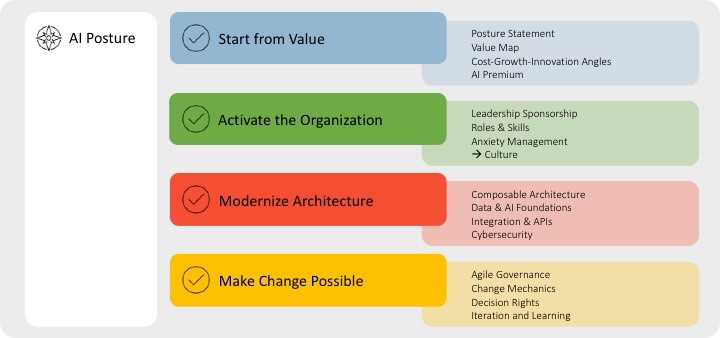
So what does deliberate preparation actually look like?
First, what it should not look like: elaborate programs, heavy governance structures, multi-year roadmaps with dozens of workstreams. McKinsey’s own researchers warn of organizations ending up with “more pilots than Lufthansa” — AI everywhere except in the profit-and-loss statement. The complexity of this challenge requires extreme simplicity in the approach. What works is a small number of clear choices, executed with discipline and very few moving parts.
Start from Value, Not Technology
The first instinct most organizations have is to ask “what can AI do?” The better question is “where would better decisions, faster processes, or sharper insights change our results?”
AI opportunities are not equal. Some reduce cost. Some accelerate growth. Some open entirely new ways of competing. McKinsey’s research shows that companies seeing the most value from AI often set growth or innovation as objectives — not just efficiency. Most organizations default to cost plays because they are measurable and safe. But growth and innovation opportunities are where the disproportionate returns are — and the only strategic insurance against disruptive newcomers. Ignoring them is how you optimize a business into irrelevance.
Practically, this does not require months of analysis. A couple of well-designed leadership-sponsored workshops yielding a one-page map of where AI fits across cost, growth, and innovation is enough to create focus. Customer service, back-office processes, and parts of supply chain are areas where standing still already means falling behind. Others depend on foundations that are not yet in place. Making that distinction visible keeps the plan honest.
In one engagement, a multinational consumer group asked a precise question: can AI turn commercial knowledge into growth while managing risk? We designed a multi-agent sales assistant — with agents handling order recommendations, revenue optimization, and policy enforcement. It achieved over 95% precision versus expert advisors, 65%+ adoption, and a significant lift in sales productivity, touching revenue in the hundreds of millions. The technology mattered. But what mattered more was starting from a business question.
Accelerate Architecture Modernization
AI deployment spans a wide range — from giving teams a Copilot to embedding intelligent agents deep inside business processes. These require very different levels of technical investment. Conflating them is a common mistake.
Even a Copilot rollout is not trivial. Deciding which documents and knowledge sources ground it — and which do not — is a real governance challenge. Get it wrong and you either expose confidential material or produce generic outputs that nobody trusts. But the alternative is worse: people quietly using consumer AI tools with no guardrails, feeding proprietary information into public models.
The deeper challenge is process architecture. The real barrier to AI at scale is not data alone — it is the ability to blend human judgment, AI agents, and data-driven insights inside day-to-day work. McKinsey describes this as moving humans “above the loop” — supervising AI-driven workflows rather than executing tasks within them. That shift demands flexible, modular platforms. Most organizations do not yet have them.
The practical approach is not to modernize everything at once. Identify the one or two integration points where rigidity is actually blocking AI, and start there. Accept tactical workarounds where the learning justifies some technical debt — but register it and use the learning to prioritize structural modernization. Temporary shortcuts that become permanent wiring are exactly how complexity becomes gridlock.
Activate the Organization
Strategy and architecture do not execute themselves. People do. The organizational side of AI is where most efforts stall.
It starts at the top. AI is a change effort, not a technology project. If the senior team is not visibly committed — setting direction, removing obstacles, orchestrating investments — the rest of the organization will read the signal and wait. Without executive sponsorship, transformation dies in the middle of the org chart.
But commitment at the top does not automatically reach mid-level managers — directors, process owners, team leads — where AI either gets woven into real work or stalls in pilot mode. These people are usually rewarded for stability, not experimentation. If you want them to change how their teams work, change the incentives. Make experimentation rational, not heroic. In areas of strategic importance, consider ring-fenced teams whose job is to experiment — with lower operational pressure and clear goals.
McKinsey’s research suggests 75 percent of roles will need fundamental reshaping in the next two to three years — including people leading teams and those who report to them. Nearly half of leaders already see skill gaps. Have an honest conversation across the organization about what AI means — the opportunities and the disruptions. The real talent threat is not AI replacing your people. It is your competitors’ people becoming dramatically more capable than yours. Offer training that connects to actual roles and real career paths — not a generic AI awareness program, but targeted skill building that helps people see themselves in the future you are describing.
Make Change Possible
Most organizations already have change processes — planning cycles, decision gates, business cases. The problem is that these mechanisms were designed for predictable, large-scale programs. AI does not work that way. Some initiatives fail fast. Others surprise. Governance needs to keep pace without suffocating progress.
One approach that works: set aside incubation investment — a defined pool of funding with lightweight access, designed to get qualifying initiatives moving quickly. Reward not just results but discipline. When people see that following the guardrails is the fastest path to resources, the guardrails reinforce themselves.
What matters most is a simple rhythm: regular review, rebalancing, and honest assessment of what is working. Not a transformation office with a 20-person staff. The value map informs where to invest in architecture. The architecture reveals what is limiting speed. The organizations that govern these as a connected system, with the lightest mechanism that works, are the ones that turn experiments into lasting advantage.
How to Start
You do not need to solve everything at once. Start with an honest view of where you are: what is ready, what is not, where the real opportunities sit, and how fast the organization can absorb change. Build a plan that balances ambition with realism, sequenced so early moves build confidence and prepare the ground for what follows.
As I argued in October — and as growing evidence confirms — the winners in AI will not be the companies running the most experiments or the most elaborate programs. They will be the ones that build the simplest system capable of learning and adjusting.
I work with leadership teams on exactly this — translating AI ambition into a practical roadmap that aligns where you want to go with what it takes to get there. If you are working through these questions, I would welcome the conversation.
References
Some articles may require paid subscriptions.
The State of AI in 2025: Agents, Innovation, and Transformation
McKinsey & Company, 2025
https://www.mckinsey.com/capabilities/quantumblack/our-insights/the-state-of-ai
The Agentic Organization: Contours of the Next Paradigm for the AI Era
McKinsey & Company, 2025
https://www.mckinsey.com/capabilities/people-and-organizational-performance/our-insights/the-agentic-organization
AI Is Everywhere. The Agentic Organization Isn’t—Yet
McKinsey & Company, 2026
https://www.mckinsey.com/capabilities/people-and-organizational-performance/our-insights/ai-is-everywhere-the-agentic-organization-isnt-yet
Five Trends in AI and Data Science for 2026
MIT Sloan Management Review, 2026
https://sloanreview.mit.edu/article/five-trends-in-ai-and-data-science-for-2026
Firm Data on AI
NBER Working Paper 34836, 2026
https://www.nber.org/papers/w34836
Why AI Won’t Wipe Out White-Collar Jobs
The Economist, 2026
https://www.economist.com/finance-and-economics/2026/01/26/why-ai-wont-wipe-out-white-collar-jobs
The Tech Jobs Bust Is Real. Don’t Blame AI (Yet)
The Economist, 2026
https://www.economist.com/finance-and-economics/2026/04/13/the-tech-jobs-bust-is-real-dont-blame-ai-yet
 Digital Transformation: A Framework