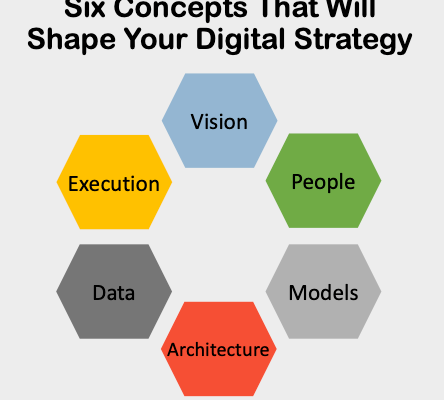
Six Concepts That Will Shape Your Digital Strategy

Six Concepts That Will Shape Your Digital Strategy: Vision, People, Models, Architecture, Data and Execution

We recently published an updated digital strategy framework to help organizations start – or restart – their digital strategies.

Drawing on years of experience and collaboration with visionary leaders, this article explores the six essential concepts at the heart of the framework. These concepts—Vision, People, Models, Architecture, Data, and Execution—offer a clear and actionable foundation for organizations to achieve transformative success, even amid the inherent complexity of the implementation.

Vision: The Catalyst for Change

At the heart of any digital strategy lies a bold and innovative vision. This vision sets the organization on a new path—or accelerates its existing trajectory—by leveraging technology as a transformative force. It is the driver that redefines what’s possible, enabling businesses to challenge and disrupt the status quo.

It’s easy to dismiss Netflix, Amazon and Uber as “digital natives”, but they exemplify how a compelling vision can revolutionize industries. By reimagining entertainment, retail, and transportation, they disrupted decades—and in some cases centuries—of established norms, leaving competitors struggling to catch up.

Netflix executed three transformative strategy pivots over three decades, each reshaping its industry. First, in the late 90s, it delighted customer eliminating late fees and decimated Blockbuster with a DVD delivery subscription model. Ten years later, it revolutionized television with on-demand streaming, replacing traditional viewing habits. Finally, Netflix disrupted Hollywood itself by producing its own content —and established binge-watching, starting with House of Cards— in the process becoming a powerhouse studio and redefining entertainment forever.

A powerful vision doesn’t merely guide technology adoption; it redefines the organization’s mission and purpose in a digital-first world. It inspires teams to think beyond incremental improvements, pushing them to explore entirely new business models and customer experiences. The vision must be ambitious yet achievable, offering a clear direction that unites stakeholders around a common goal.

People: The Driving Force Behind Transformation

While technology is an enabler, people are the true rainmakers of digital innovation. From executives to frontline employees, the success of a digital strategy depends on the creativity, expertise, and commitment of the organization’s workforce.

Digital transformation starts at the top, with leadership embracing their role as champions of change. The CEO and executive team must drive the vision, ensuring alignment across all levels of the organization. However, transformation cannot stop at the leadership level. A digital strategy requires a cultural shift that permeates every corner of the organization, encouraging innovation, collaboration, and a willingness to challenge the status quo.

Empowering teams with the skills, tools, and autonomy to experiment and iterate is critical. As technology becomes increasingly commoditized, it is the ingenuity and determination of people that will differentiate successful organizations from their competitors.

Models: Unlocking Innovation Through Disruption

Identifying opportunities for innovation should be first step of any digital strategy. Yet, even creative business leaders sometimes struggle to envision what to transform, especially in traditional industries where long-standing practices and structures dominate.

This is where the Models component of the framework comes into play. By disassembling the business model, customer lifecycle, and operating frameworks, organizations can uncover hidden opportunities for disruption and growth.

This process of creative deconstruction allows leaders to think like startups—challenging established paradigms and imagining new ways to deliver value. Whether it’s rethinking customer engagement, rewiring supply chains, or introducing new pricing models, the possibilities are endless. The goal is to create structural and lasting competitive advantages that set the organization apart in a crowded marketplace.

Architecture: Building the Foundation for Innovation

Once new business models and processes are identified, the next step is to design a Digital Business Platform that brings them to life. The Architecture component of the framework focuses on building a modular, flexible, and scalable infrastructure that enables rapid innovation and adaptation. This requires more than just adopting state-of-the-art technology—it demands a fundamental rethinking of how processes and models are reflected in technology.

Digital leaders are not afraid to start with a blank slate, rebuilding their IT tech stacks and engineering practices to enable composable designs that align with operational capabilities. These architectures must enable seamless integration across legacy systems, cloud platforms, and emerging technologies.

None of the organizations we worked with over the past decade had architecture functions configured to drive digital innovation effectively from the outset. But with the right approach, they were able to build teams to support agile, customer-centric operations and enable transformative growth.

Data: The Nervous System of the Digital Enterprise

Data is the central nervous system that connects every moving part of the organization. To succeed, businesses must skillfully capture, manage, and analyze data. The goal is to create a unified data repository that removes silos, enables efficient execution and becomes a single source of truth that informs decision-making, uncovers insights, and drives innovation. This often requires overhauling existing data models, architectures, and governance practices.

The importance of data-driven decision-making has grown exponentially with advancements in analytics and AI. These technologies offer organizations unprecedented opportunities to understand customers, optimize operations, and uncover new pockets of growth.

However, building a data-driven culture takes time and effort. It requires robust governance structures, seamless integration of data assets, and a commitment to turning raw data into actionable intelligence.

Execution: Connecting Strategy to Results

The final concept—Execution—is where ambition meets reality. Execution is about connecting all the pieces of the digital strategy with agility, precision, and a relentless focus on value.

It starts with a solid strategic execution discipline, ensuring that initiatives and investments are aligned with business priorities and measured against clear performance targets. Organizations with well-established strategic execution practices have a significant advantage, as they can integrate digital initiatives into existing management processes and drive results more effectively.

Success requires a remarkable commitment to managerial hygiene: plan, execute, measure, adjust, and repeat. While this may sound straightforward, the graveyard of failed digital transformations proves that it’s anything but. According to McKinsey & Company, approximately 70% of digital transformation initiatives fail to achieve their intended goals. Leaders must prioritize alignment, accountability, and continuous learning, ensuring that the organization remains focused on implementing change and delivering meaningful outcomes. Digital innovation is a marathon, not a sprint.

The six concepts—Vision, People, Models, Architecture, Data, and Execution—are the foundation of a successful digital strategy. They offer a structured yet flexible framework that empowers organizations to navigate the complexities of digital innovation with confidence.

Rewired: The McKinsey Guide to Outcompeting in the Age of Digital and AI

Authored by experts at McKinsey, this guide is a comprehensive and insightful exploration into the transformative power of digital technologies and artificial intelligence. They meticulously outline the frameworks and methodologies that successful companies have employed to not only adapt but thrive in the rapidly evolving digital era. It presents a blend of theoretical insights and practical applications, making it a valuable resource for business leaders aiming to navigate the complexities of digital transformation.

One of the standout features of “Rewired” is its pragmatic approach to integrating digital and AI technologies into existing business models. The authors emphasize the importance of aligning digital initiatives with core business strategies, ensuring that technological advancements contribute to business goals. The book is full of case studies and real-world examples, illustrating how various organizations have successfully implemented digital transformations. These examples provide readers with tangible, actionable insights that can be adapted to their unique business contexts. Additionally, the guide addresses common challenges and pitfalls associated with digital transformation, offering solutions and best practices to mitigate risks and maximize returns.

“Rewired” highlights the human aspect of digital transformation, focusing on the crucial role of leadership, culture, and talent management. Aligned with the core tenants of this blog, the authors argue that while technology is a powerful enabler, the true drivers of transformation are the people within the organization. They provide strategies for nurturing a culture of innovation, continuous learning, and agility, which are essential for sustaining competitive advantage in the age of digital and AI. Overall, “Rewired” is an indispensable resource for any business leader seeking to harness the full potential of digital and AI technologies, offering a roadmap to outcompete and excel in the modern business environment.

Rewired: the McKinsey Guide to Outcompeting in the Age of Digital and AI
by Eric Lamarre, Kate Smaje, Rodney Zemme

Fast Times: How Digital Winners Set Direction, Learn, and Adapt

In Fast Times, a team of McKinsey consultants share the recipe they apply to help their customers be first movers and win the digital race.

“[Fast Times] is for senior executives who are frustrated by the slow pace and limited return on investment (ROI) of their digital transformations, and are unsure what’s holding them back” in the word of the authors.

While not a detailed blueprint to design a Digital Transformation initiative, they cover critical imperatives to develop a Strategy, Capabilities, Adopt and Scale, and they cleverly do it answering provocative questions like “Are you clear about the which transformation model is best for your company?” or “Have you hired digital stars?”

They provide insightful tips on Speed, Scale, Talent and Culture. A must read for leaders already embarked in a digital journey or in need of a reset.

Fast Times: How Digital Winners Set Direction, Learn, and Adapt
by Arun Arora, Peter Dahlstrom, Klemens Hjartar, and Florian Wunderlich

Digital Transformation Is Not About Technology

Most business executives think – often reflected by who they bring to the room when you discuss the topic with a CEO – that Digital Transformation is about technology. It is not.

Certainly, top notch technology capabilities are a critical ingredient in all Digital Transformation success stories, but there is a lot more to it. This is the purpose and central theme of this blog: debunking the notion that technology is the most important factor in making a start-up or centuries old companies more competitive with digitally driven innovation, and expanding the field of view of executives to include the broader set ingredients that they will have to mix and match to lead their companies into the digital future.

Digital Before Transformation

Software is eating the world. In a now famous 2011 Wall Street Journal piece, technology entrepreneur and venture capitalist Marc Andreessen brilliantly made the case of why most companies were in the way of becoming software companies – across industries, from entertainment and banking to cars, retail and logistics.

“Six decades into the computer revolution, four decades since the invention of the microprocessor, and two decades into the rise of the modern Internet, all of the technology required to transform industries through software finally works and can be widely delivered at global scale” he wrote.

While banks still own branches, airlines fly planes and Amazon last year ordered 100,000 electric delivery trucks, technology is now in charge of engaging with customers, managing risk and fares, or deploying assets – and make companies winners or losers depending on how good their algorithms are.

Most of the underlying technology has been around for some time. But now its maturity, ubiquity, and affordability – and the ingenuity of the engineers, entrepreneurs and innovators deploying it – are giving it a dramatically more significant role in shaping business models and strategies. A Transformative role.

Time to Transform

Some industries and companies can be wholly reconfigured by technology – remember Blockbuster or Tower Records? – but not all. McKinsey puts is very well: “the number of companies that can operate as pure-play disrupters at global scale are few in number, and rarer still are ecosystem shapers that set de facto standards and gain command of the leverage created by hyperscaling digital platforms.”

But even in asset or activity-intense sectors that can’t be entirely switched to digital-only experiences, modern technology is driving major change, and visionary executives the world over have taken note and quietly started reshaping strategies, business models and organizations to exploit these new opportunities. They updated their leadership styles, cultures and platforms to design and deploy entirely new ways of doing things. They embarked in a Digital Transformation.

The Impact

Academics and consulting outfits have very carefully analyzed the advances in digitization and linked them with financial performance, and the relationship is undeniable.

A seminal two-year study by the MIT Sloan School of Management analyzed more than 400 large firms and found that digitally transformed businesses are 26% more profitable than their industry competitors, drive 9% more revenue through their employees and physical assets and are 12% more valuable than their peers.

The researchers developed a digital maturity model to show how different companies are reacting to technological opportunity, and cleverly analyzed how businesses invest in technology, but more importantly, how the true leaders create the leadership and change management capabilities necessary to drive innovation, which they called transformation management intensity.

They proved that the ability to modernize strategies, organizations and processes is as – or more – important than the technology itself in the quest to be a digital leader.

Another by McKinsey found that focusing on the right digital practices, B2B companies –currently trailing B2C companies in digital maturity – can create long-term value, with the most advanced in their transformation programs driving five times more revenue growth than their peers.

Digital Leadership

Digital transformation is about Strategy, People, Innovation and Execution. Photo by standret.

So, what is Digital Leadership about then?

It is about reinventing strategies, operating models, and processes. It is about putting the customer in the center of attention of the entire organization and designing their experience from the outside in. It is about fact driven decision making and agile change management.

It is about fostering a culture of nonstop innovation and fearless renewal, of mercilessly abandoning established ways of doing things and adopting digitally enabled models.

Technology allows all of this, from the advanced analytics platforms that support decision making and action to the omnichannel platforms that support seamless customer experiences. From process automation to remote collaboration. But despite the broad availability and growing affordability, technologies alone are useless without the leadership to drive change.

Transformation is more important than Digital. And Transformation is about Strategy, People, Innovation and disciplined Execution, the components of the framework proposed in this blog.


Originally written late 2017, updated December 2020.

Bridging the Leadership Gap Between Tech and Business

IT has a credibility problem – from C-suite stakeholders to individual contributors – who have come to associate IT with bottlenecks, frustration, constraints, and cost overruns. Yet, for many organizations, technology is the business, and it needs to be understood as a critical enabler in every stage of the business cycle, from the front line to the back office.

Based on his experience working with technology leaders, the author, partner with Bain & Company in Chicago, describes how visionary leaders bridge the gap between technology and business.

Bridging the Leadership Gap Between Tech and Business
By Will Poindexter
MIT Sloan Management Review, July 2019

The Agile C-Suite

A new approach to leadership for the team at the top.

If a company wants to be very fast, thoroughly transform customer experiences, and systematically outperform competitors, it needs more than many agile teams. A truly agile company requires that the company’s top officials, most, if not all, of the top executives, also adopt agile principles.

Writing for Harvard Business Review, a team of Bain & Company consultants describe how such an agile leadership team works, how it differs from the conventional corporate-style executive committee and other agile teams, and what agile means for the day-to-day work lives of senior executives.

While the job of a conventional agile team is to create innovative solutions to a problem, an agile leadership team aims to strike the right balance between standardizing operations and pursuing innovation.

The Agile C-Suite
by Darrell Rigby, Sarah Elk, and Steve Berez
Harvard Business Review, May–June 2020

Building Digital-Ready Culture in Traditional Organizations

Interviewing executives and employees at more than two dozen digital and in-transition companies and then surveying employees in over 500 digital and traditional companies, the researchers identified the values and practices from digital culture that make sense to transplant to traditional companies as they embark in their digital transformation journey.

They identify impact, speed, openness and autonomy as the four key values of digital culture, and then extrapolate them with eight digital and traditional practices to promote innovation without sacrificing the integrity and stability that enable a healthy workplace.

They support the empiric research with real-life examples.

Building Digital-Ready Culture in Traditional Organizations
By George Westerman, Deborah L. Soule, and Anand Eswaran
MIT Sloan Management Review, May 2019

The Technology Fallacy: How People Are the Real Key to Digital Transformation

Digital technologies are disrupting organizations of every size and shape, leaving managers scrambling to find a technology fix that will help their organizations compete. This book offers managers and business leaders a guide for surviving digital disruptions―but it is not a book about technology. It is about the organizational changes required to harness the power of technology. The authors argue that digital disruption is primarily about people and that effective digital transformation involves changes to organizational dynamics and how work gets done. A focus only on selecting and implementing the right digital technologies is not likely to lead to success. The best way to respond to digital disruption is by changing the company culture to be more agile, risk tolerant, and experimental.

The Technology Fallacy: How People Are the Real Key to Digital Transformation
By Gerald C. Kane, Anh Nguyen Phillips, Jonathan R. Copulsky and Garth R. Andrus

The Digital Future: A Game Plan for Consumer Packaged Goods

Written six years ago, the robust analytical groundwork makes this paper a good read today. Furthermore, many of the recommendations are mainstream strategic plays in present-day toolboxes.

After outlining realities and challenges and how that game has changed, the authors argue that CPG companies should quicky move beyond establishing a digital presence—a website, some digital advertising, a presence in social media—and fully integrate digital into their operating model, build a big-data analytical capability, pursue a multichannel (or omnichannel) strategy, or tailor their product offerings to the digital or e-commerce marketplace

Their recipe to Playing the New Game to Win:

  • Develop an integrated strategy
  • Build brand equity online
  • Revisit category management across channels
  • Partner with retailers
  • Rethink supply chain configuration
  • Test, learn, scale
  • Build an adaptive organization
  • Manage internal tensions

Retrospectively, a missing item in this top-level list is advanced Data Analytics.

The Digital Future: A Game Plan for Consumer Packaged Goods
Patrick Hadlock, Shankar Raja, Bob Black, Jeff Gell, Paul Gormley, Ben Sprecher, Krishnakumar (KK) S. Davey, and Jamil Satchu
Boston Consulting Group, 2014