

Generative AI arrived quickly, with bold promises dominating headlines. But anyone who has lived through past technology shifts knows the real story: the hard job of driving value is not proving it can work – it is adopting it to transform how companies work. Just as with PCs, e-commerce, or mobile, impact will not be fast or easy.
Customers, colleagues, and friends — nearly everyone I exchange perspectives with is already using GenAI to work faster, smarter, and better. That matches findings from a recent paper by Andrew McAfee and colleagues, which shows the technology delivering rapid productivity gains across many occupations. (And yes, I used GenAI tools in researching this article.)
The challenge is that individual gains – especially in knowledge-based work – don’t automatically scale into business or economic impact, at least in most sectors. To matter, they must flow into optimized processes, unit economics, and value levers like prices, margins, or productivity in high-volume workloads. As McAfee and his co-authors note, that means “complementary innovations and organizational reinvention.”
The good news is we finally have some evidence to work with. Early experiments show where AI can create traction and where it tends to stall. They also make one thing clear: getting value out of AI means tough choices and visible commitment from the top team.
The Road to Structural Gains
Across industries, AI pilots are everywhere – copilots for coders, chatbots for service, tools to automate routine tasks. They show what’s possible, but most remain stuck at the pilot stage. Local productivity improves, yet the broader structure of how work gets done stays the same.
This is familiar. Every major technology shift follows a pattern: early enthusiasm, a rush of experimentation, and only later the hard work of embedding new tools into the fabric of business.
The PC revolution is a widely researched case. Email, spreadsheets, and collaboration tools became available in the 1980s. Yet measurable productivity gains only showed up in the mid-1990s, once workflows were redesigned, people retrained, and cultures changed. It took 15 years before the technology showed up in macroeconomic statistics.
E-commerce followed a similar path. Despite 30 years of innovation, investment, and exceptional consumer convenience, only about 16% of U.S. retail spending is online today.
Gartner’s 2025 Hype Cycle places generative AI just past the Peak of Inflated Expectations, signaling that today’s surge of pilots and proofs of concept will only translate into value once organizations take on the harder work of reinvention.
Generative AI is best understood as a general-purpose technology, much like electricity, PCs, or the internet: broad in potential, but dependent on complementary change before its impact can be fully realized. Research by Andrew McAfee and colleagues suggests this wave could diffuse faster than earlier ones because the infrastructure is already in place, tools are widely accessible, and adoption often requires less retraining. Yet the speed of progress still depends heavily on an organization’s own maturity – some have ways of working and modern tech stacks ready to absorb AI, while others face years of groundwork before they can capture meaningful value.
Early signals remain ambiguous. A Stanford study found that workers aged 22–25 in AI-exposed roles saw employment fall by about 13% since 2022, while more experienced peers held steady – suggesting the first effects of AI might be showing up in hiring rather than productivity. A more recent analysis from Yale’s Budget Lab offers a different lens: instead of losses, it examines shifts in the occupational mix – which tasks are being automated, which are being augmented, and how work itself is changing as AI spreads. Apparent declines in some roles may instead reflect a reallocation of tasks. The evidence remains faint — more about changing work than vanishing jobs.
As a technology executive and entrepreneur who lived through the dot-com wave, the rise of e-commerce, mobile, and social media, I’ve seen this pattern repeat: first the hype, a dose of disillusionment, and finally the long, grinding work of structural change. Generative AI may spread faster than past waves, but the hard job to generate value will be the same.
Why AI Value Will Be Slow to Materialize
Integration Matters More than Deployment
Customer service bots, document summarizers, and coding copilots are easy to deploy. They spread fast but don’t transform most industries. The next step is Agentic AI – systems that combine business logic and different types of AI to perform multi-step workflows, interact with humans, and span business functions.
The challenge is integration. Agents don’t operate in isolation. They need redesigned interfaces and workflows: decision points, exception handling, escalation rules, and system integration. As McKinsey observed after studying 50+ agentic AI builds: “It’s not about the agent, it’s about the workflow.”
“Fewer than 10% of generative AI use cases have made it past the pilot stage.”
“Only 21% of organizations using gen AI report that they have fundamentally redesigned at least some workflows.”
“Among the 25 organizational practices tested, workflow redesign has the strongest relationship with reported EBIT impact.”
– McKinsey, State of AI: How Organizations Are Rewiring to Capture Value (2025)
Reengineering Operating Models
Some industries will see direct disruption – translation, for example, where AI can deliver acceptable quality at near-zero cost. But most require operating model reinvention: reconfiguring how decisions are made, how accountability flows, and how value is created.
McKinsey’s State of AI 2025 survey illustrates the gap: “Fewer than 10% of generative AI use cases have made it past the pilot stage.” Tools are spreading, but few firms have revamped their operating models to absorb them.
No Sustainable Edge in Base Technology
Generative AI is trained on public domain knowledge and released broadly. As MIT Sloan has argued, AI itself is unlikely to provide sustainable competitive advantage.
McKinsey’s survey is blunt: “Only 21% of organizations using gen AI report that they have fundamentally redesigned at least some workflows. Among the 25 organizational practices tested, workflow redesign has the strongest relationship with reported EBIT impact.”
The edge comes from differentiated data, proprietary processes, and organizational creativity. Cloud platforms can be acquired easily; unique ways of working cannot.
The Human Factor
AI changes organizational dynamics. Vertical supervising tasks give way to orchestrating systems of people and agents. Leaders must re-skill employees, manage resistance, and build trust in AI-driven systems.
Human-in-the-loop design is critical. Generative AI introduces risks of hallucinations, bias, and IP leakage that can’t be solved by technology alone. In a Harvard Business Review article, Andrew McAfee and his co-authors argue that employees need to be trained to recognize these risks, escalate them, and build confidence in using AI responsibly.
And it’s not only frontline or entry-level roles. A recent MIT Sloan article argues that AI will increasingly automate coordination and monitoring – traditional managerial functions – while creating demand for new roles in oversight, design, and orchestration.
Adoption will be uneven. Early enthusiasts embrace new tools; skeptics push back, especially after errors. Clear accountability, transparent communication, and cultural adaptation are as critical as technical readiness.
Platform Readiness: Data, Systems, and Governance
Finally, structural adoption depends on platform readiness. AI requires clean, governed data — still a rarity in most organizations. Just as critical is the underlying architecture: many ERP, CRM, and supply chain systems are built on rigid interfaces and hard-coded business logic. To take advantage of AI, those systems need more flexible designs that can support dynamic workflows. AI can’t be simply bolted onto legacy systems.
Governance must also mature alongside technology. Privacy, compliance, and risk management can’t wait until systems are scaled if they are exposed to the outside world – they need to be embedded from the start.
The Productivity Promise Is Still Real
Despite these challenges, the long-term upside is enormous. McKinsey estimates that Agentic AI could unlock $450–650 billion annually by 2030 in advanced industries such as manufacturing, logistics, and energy.
Functions like supply chain, software development, and customer service can all be reimagined. But because the base technology is broadly available, the competition to innovate will be fierce. The winners will be those that integrate faster and deeper, building on proprietary assets.
From my experience with past technology shifts, this is where the champions pull ahead. When mobile and social networks disrupted consumer engagement, the companies that succeeded weren’t the ones with the flashiest apps – they were the ones that cleverly reimagined marketing, sales, and service for two-way, mobile-first interactions. The same will be true with AI.
From Experimentation to Transformation
The practices below reflect what I’ve seen in working with clients, along with insights from global leaders and academics. Together, they highlight what helps organizations move beyond experimentation toward real transformation.
Activate the Leadership Team
Transformation begins at the top. This is not just a technology project but a significant change effort. The senior team has the credibility to ask the hard questions, the clout to mobilize resources quickly, and the leverage to remove obstacles. If they aren’t in the room and visibly committed, the rest of the organization will sense it – and resistance will dampen progress.
Map Opportunities
With customer teams, we start broad and deep. The goal isn’t just to identify obvious efficiencies, but to uncover disruptive opportunities. We map ideas across two dimensions: strategic business pillars, and the angles of innovation that AI can unlock.
This stage is about thinking differently – exploring what could change the rules of the game rather than just automate today’s tasks. It’s a step for conceiving opportunities, not a commitment to chase them all.
Invest in a Balanced Portfolio
Once opportunities are conceived, the next step is to commit to a portfolio that balances ambition with pragmatism. In practice, the portfolios that resonate most with leadership teams usually contain three kinds of bets: disruptive ideas that carry risk but could redefine value creation; quick wins that deliver visible results and momentum; and defensive moves that may not create lasting advantage but are quickly becoming industry baseline.
Start with the Questions
AI is not an end in itself. The right starting point is a business question: If I could forecast X more accurately, what would change? If I could automate Y, how much capacity would I free up?
One industrial client is embedding AI agents into a reactive B2B service chatbot. The initial aim is faster response, but the next goal is to extend into proactive commercial processes – identifying cross-sell opportunities, guiding orders, anticipating needs. The key question wasn’t an open-ended “what can AI do,” but “can AI turn knowledge into growth while managing risk up front?”
Advance Initiatives and Capabilities
Run promising use cases first but do so with discipline: set substantial business goals, track adoption and value, and be ready to kill experiments that don’t deliver. In parallel, invest in the capabilities that enable scaling: data assets, governance, orchestration technology, and workforce skills.
One of my retail clients launched a Copilot program to organize and classify knowledge. The first phase focuses on individual and small team productivity, but the explicit goal is to mature into AI-enabled collaborative innovation. Sequencing matters: early initiatives build experience and momentum, while capabilities ensure the organization is ready to accelerate what works.
Close Business, Technology, and Risk Collaboration
AI can’t sit in a technical silo. Business leaders must co-own initiatives. To build trust and ensure each step forward stands on firmer ground, risk and compliance need to be involved from the start. Governance has to be continuous, with clear paths for when agents fail.
One useful approach, highlighted in HBR and practiced by most early adopters, is to move deliberately in stages: experiment in a sandbox, then run tightly scoped pilots, and only scale once risk and governance structures are proven to hold.
The Case for Simplicity
When teams start mapping AI opportunities, the challenge isn’t scarcity – it’s abundance. The possibilities are endless, and the actions required to pursue them quickly become complex and interdependent. Without a simple top-level frame, discussions can fragment across business, operations and technology perspectives.
A practical way to bring structure is to group AI applications into broad categories, for example:
Predictive & Optimization – improving foresight and decision quality through analytics and modeling.
Autonomous Decision & Action – embedding intelligence into processes that can sense and act in real time.
Knowledge-Management & Generative – expertise, content, and amplifying human capability.
End-to-End – connecting and orchestrating workflows across functions to create compound value.
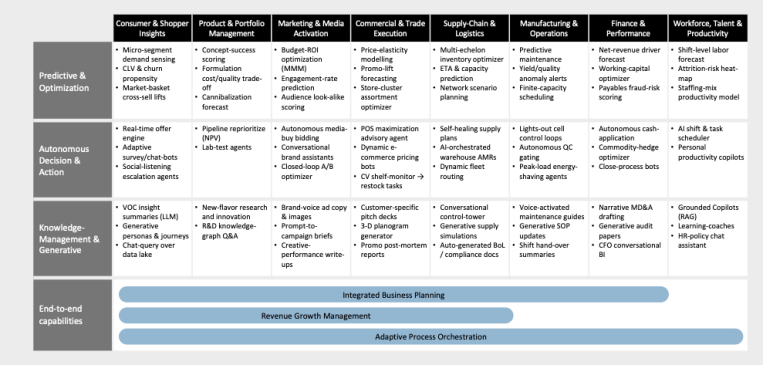
This structure, borrowed from a recent workshop, isn’t meant to be followed verbatim – it must be reframed based on each organization’s industry and AI posture, and paired with strategic pillars to give a full 360-degree view. It simply shows how to organize a portfolio around general concepts rather than specific technologies or use cases.
The Takeaway
AI opens unprecedented opportunities but is not a silver bullet. Pilots and use cases are necessary, but they are not sufficient. Like PCs, e-commerce, and mobile before it, AI’s real value will only come when organizations reinvent their structures to embed it deeply in business and operating models.
The winners won’t be those who run the most experiments. They will be the organizations willing to rewire themselves so that AI becomes part of the fabric of how business is done. For leaders, that means rolling up your sleeves and doing the hard job of transformation.
References
The impact of generative AI as a general-purpose technology
MIT Sloan School of Management, 2024
https://mitsloan.mit.edu/ideas-made-to-matter/impact-generative-ai-a-general-purpose-technology
Canaries in the Coal Mine? Six Facts about the Recent Employment Effects of Artificial Intelligence
Stanford Digital Economy Lab, 2025
https://digitaleconomy.stanford.edu/publications/canaries-in-the-coal-mine/
Evaluating the Impact of AI on the Labor Market: The Current State of Affairs
Yale Budget Lab, Yale University, 2025
https://budgetlab.yale.edu/research/evaluating-impact-ai-labor-market-current-state-affairs
One Year of Agentic AI: Six Lessons from the People Doing the Work
McKinsey & Company, 2024
https://www.mckinsey.com/capabilities/quantumblack/our-insights/one-year-of-agentic-ai-six-lessons-from-the-people-doing-the-work
The State of AI: How Organizations Are Rewiring to Capture Value
McKinsey & Company, 2025
https://www.mckinsey.com/capabilities/quantumblack/our-insights/the-state-of-ai
Why AI Will Not Provide Sustainable Competitive Advantage
MIT Sloan Management Review, 2025
https://sloanreview.mit.edu/article/why-ai-will-not-provide-sustainable-competitive-advantage/
How to Capitalize on Generative AI
Harvard Business Review, 2023
https://hbr.org/2023/11/how-to-capitalize-on-generative-ai
Why Robots Will Displace Managers – and Create Other Jobs
MIT Sloan Management Review, 2025
https://sloanreview.mit.edu/article/why-robots-will-displace-managers-and-create-other-jobs/
The Economic Potential of Generative AI: The Next Productivity Frontier
McKinsey & Company, 2023
https://www.mckinsey.com/capabilities/mckinsey-digital/our-insights/the-economic-potential-of-generative-ai-the-next-productivity-frontier


 Digital Transformation: A Framework