
Key Concepts
- Microsoft’s digital business platform vision has been developed over time, combining modular business applications, flexible infrastructure, and structurally embedded AI.
- Dynamics 365 provides a composable architecture at multiple levels: business domain modularity, application modularity, and separation of data, logic, and user interfaces.
- Dataverse and Microsoft Purview deliver a unified operational data layer and governance framework for data quality, consistency, and compliance.
- Microsoft Fabric integrates real-time analytics, operational reporting, and AI-driven insights into a unified environment, enabling continuous intelligence.
- Power Platform enables low/no-code development, extending business applications and workflows.
- Azure platform services – hosting, identity governance with Microsoft Entra, CD/CI with Azure DevOps and monitoring with Azure Monitor.
- Multi-vendor platform with systems like SAP S/4HANA can be integrated through API-first models, identity federation, DevOps pipelines, and unified monitoring.
This article follows on from Digital Business Platform: A Reference Architecture to Accelerate Digital Metabolism, moving from architectural principles into practical implementation and outlines how Microsoft’s technology ecosystem –Dynamics 365, Azure, and Microsoft Fabric – can be engineered to realize a composable, scalable digital business platform.
Microsoft’s vision has developed over time, shaped by three complementary dimensions that reflect a long-term platform strategy under the leadership of Satya Nadella: business applications as a platform, elastic cloud infrastructure as an enabler, and Data and AI as a ubiquitous, embedded capability across the stack.
Microsoft continues to develop its technologies with a platform-oriented mindset – supporting open standards, architectural extensibility, and modular design. This guiding principle is reflected in recent developments, like the announced support for Model Context Protocol (MCP) and Open Agent2Agent (A2A) standards originally created by Anthropic and Google respectively.
A Platform Approach to Business Applications
In the mid 2000s, Microsoft Business Solutions (now Microsoft Dynamics) was formed with a clear architectural ambition: business applications needed to be modular, extensible, and designed as a platform. One of the most consequential moves was the acquisition of Navision, whose Axapta product – later Dynamics AX and eventually Dynamics 365 – was built with distinct data, business logic, and UI layers. This architecture predates composability principles but laid the foundation for a suite of modular applications spanning finance, operations, sales, marketing, and service.
Azure: Cloud Infrastructure
In parallel, Microsoft built Azure as a global infrastructure-as-a-service (IaaS) platform to support this modular vision. More than a hosting environment, Azure was designed to be open and interoperable, capable of supporting Microsoft-native, open-source, and third-party technologies. It includes all foundational elements of a digital business platform – identity, security, integration, observability, and operations – and acts as the connective tissue that links business applications, analytics engines, and operational systems into a cohesive whole.
Azure also enables modern software engineering practices. Team Foundation Server (TFS), launched in 2005, introduced early CI/CD capabilities. It eventually evolved into Azure DevOps, which today supports high-velocity, modular, distributed delivery pipelines at scale.
AI: Intelligence Embedded Across the Platform
The third dimension – artificial intelligence – has increasingly become an integral layer within Microsoft’s platform strategy. Far from being treated as a separate system, AI is embedded into applications, development tools, and infrastructure services. Azure AI and Microsoft Copilot technologies exemplify this convergence: enabling natural language interaction, automating complex workflows, enriching analytics, and accelerating software development itself. AI is not simply layered on top of the platform – it is woven through it, transforming how capabilities are delivered, consumed, and scaled.
Implementation Blueprint
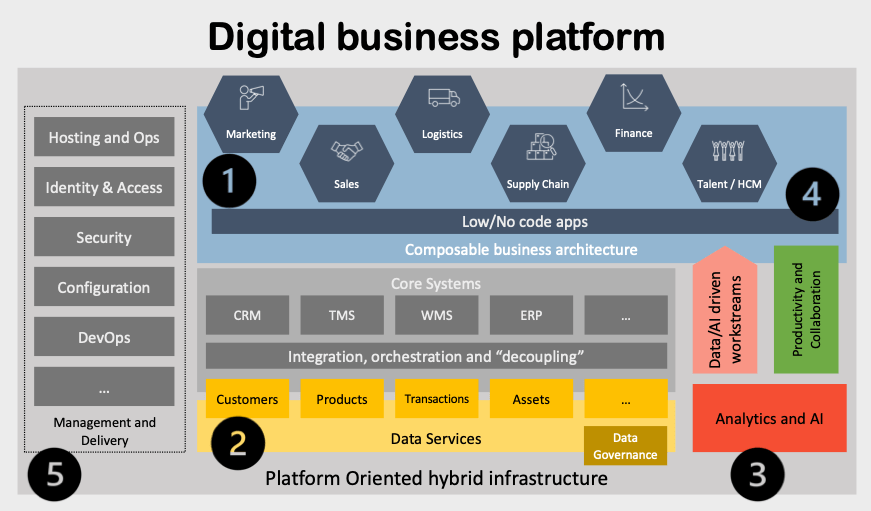
A digital business platform is not a single product or solution, but an architectural model for assembling modular technologies into a unified, scalable foundation to manage the infrastructure. It integrates core business applications, shared data services, analytics and AI engines, low-code tools, and modern infrastructure under a common governance model. The goal is to create a composable environment where capabilities can be deployed, extended, and reconfigured dynamically in response to business needs.
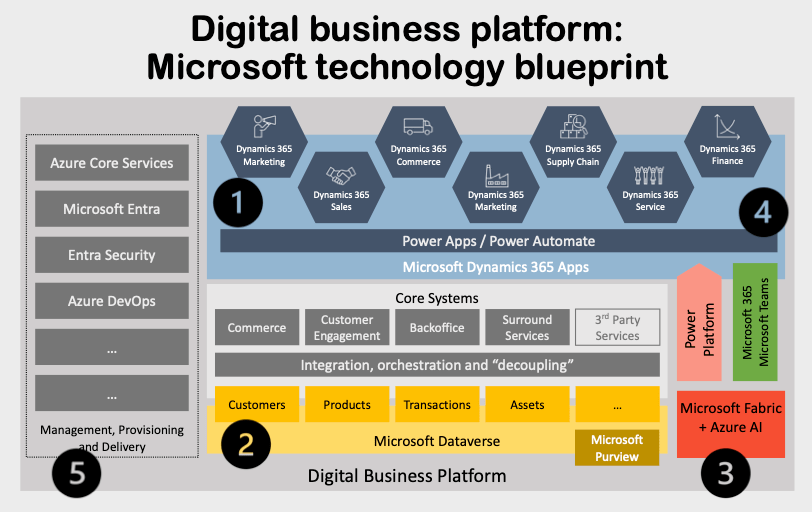
This blueprint outlines how Microsoft’s ecosystem – Dynamics 365, Azure, Microsoft Fabric, and Power Platform – can be engineered to implement a full-scale digital business platform. While based on Microsoft technologies, the architecture is vendor-neutral by design, enabling the structural adoption of systems such as SAP as first-class components. The document is structured around five layers: business applications, data services, analytics and AI, low-code, and platform management, and an extension exploring multi-vendor architecture.
1) Composable Business Architecture
True composability is achieved when business capabilities are modularized at different layers of the application and data stack. Microsoft’s modern business application ecosystem realizes this principle through three nested forms of modularity:
Macro Modularity: Independent Applications by Business Domain
At the highest level, Dynamics 365 offers a set of independent but interoperable applications organized around major business domains – commerce, finance, supply chain management, customer service, etc.

Each application is built to be deployable individually or in combination with others, enabling organizations to adopt and expand their platform gradually, based on business needs. This modular application approach allows organizations to compose and recompose their digital operations as market conditions and strategies evolve.
Application Modularity: The Case of Dynamics 365 Commerce
Zooming in, each Dynamics 365 application itself is designed with modularity in mind. Dynamics 365 Commerce, for example, structures its internal architecture to support composability across retail channels, back-office operations, call centers, and e-commerce sites. Core subsystems – such as the Retail Server, Channel Database, and Commerce Scale Unit – are modular components that can be configured, scaled and extended independently, depending on channel-specific needs.
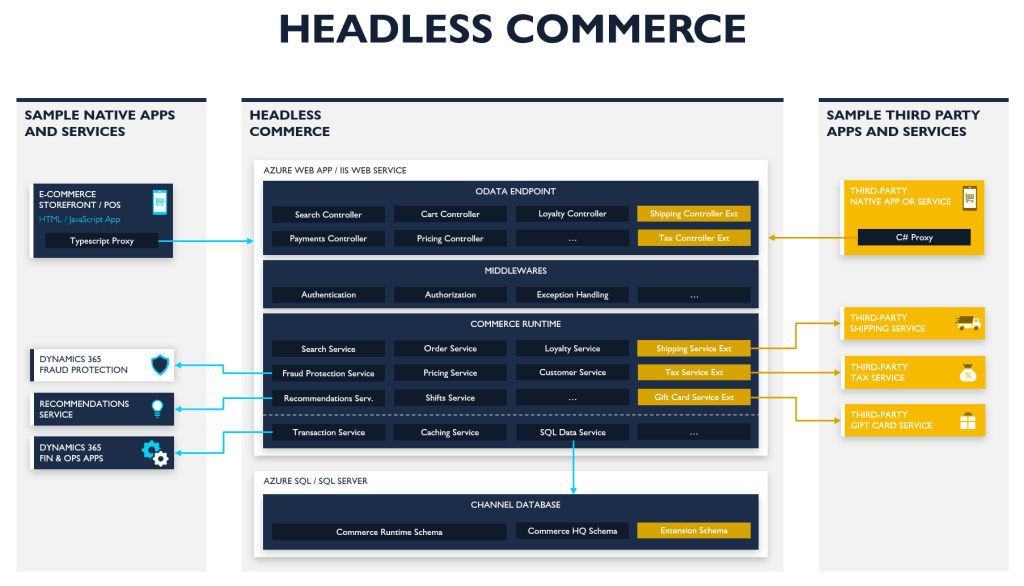
This modular design allows for greater operational flexibility and agility, enabling rapid rollout of new experiences across physical and digital storefronts without massive reengineering of backend systems.
Data, Logic, and UI Separation: Headless Engineering
The separation of data, business logic, and user interface is a fundamental modularity principle implemented in Dynamics 365 Commerce’s headless commerce model. In this design:
- Commerce APIs expose business logic and data independently of any specific user interface.
- Retail Server serves as an orchestration layer between front-end applications and core business services.
- Channel Databases and Commerce Runtime (CRT) services maintain data and transactional integrity across retail stores and e-commerce channels.
This separation enables unique customer experiences across channels and devices while relying on consistent, reusable business processes underneath. Custom front-end applications (for example embedded in a branded mobile app), third-party platforms, and Microsoft Power Platform connectors can all consume these APIs to build tailored solutions, enabling a true omnichannel strategy.
API-First Integration: Building for Composability
An API-first integration approach guides all layers of modularity. Dynamics 365 Commerce APIs, delivered via OData protocols and Web API standards, offer standardized, discoverable interfaces that support both first-party (Microsoft) and third-party application development.
This model-driven, API-centric design:
- Decouples service consumers from service implementations
- Enables external systems to access business services cleanly and securely
- Facilitates agility and scalability in integrating new applications, devices, or platforms
Support for industry standards like OData (an OASIS Open Standard) ensures that integration approaches are interoperable across ecosystems, whether consuming APIs directly from Dynamics 365 applications or via connectors.
2) Data Services
The digital business platform requires a unified data service capable of supporting operational transactions, integrating across applications, and providing governance across environments. Microsoft’s Dataverse, combined with Microsoft Purview and Azure integration services, addresses these needs within a modular and standardized framework.
Dataverse: Operational Data Layer
Dataverse provides a structured and secure environment to manage operational data models across business applications. Key capabilities include:
- A standardized schema for common business entities (customers, products, transactions)
- Support for role-based access control and security policies
- Metadata services for defining validations, relationships, and business rules
- Native integration points with Dynamics 365, Microsoft 365, Azure services, and the Power Platform ecosystem
Dataverse abstracts storage complexity, allowing applications to interact with business data through a consistent and scalable service layer.
Data Governance: Microsoft Purview Integration
Microsoft Purview extends governance capabilities across Dataverse and connected data sources:
- Register and scan environments to catalog assets and track data lineage
- Define and enforce data policies, classifications, and retention strategies
- Manage compliance and data protection across multi-cloud, on-premises, and SaaS environments
Purview standardizes governance processes, supporting auditability and operational compliance without duplicating management efforts.
Data Integration and Interoperability
Dataverse supports integration through an OData-compliant API surface, providing a standardized REST-based protocol for external and internal service communication:
- Direct exposure of entity data models for programmatic access
- Compatibility with OData-enabled platforms like SAP Gateway
- Integration with external services via standardized connectors, such as Informatica’s OData Connector
This architecture supports loose coupling between systems, enabling dynamic integration patterns across operational and analytical workflows without requiring bespoke adapters or point-to-point configurations.
3) Analytics, AI, and Data-Driven Workstreams
A digital business platform must integrate operational and analytical layers to enable data-driven processes across the enterprise. Microsoft Fabric provides an end-to-end environment for integrating, managing, analyzing, and visualizing data, connecting directly with operational sources such as Dataverse and Dynamics 365.
Fabric as the End-to-End Analytics Platform
Microsoft Fabric consolidates data integration, engineering, data science, real-time analytics, and business intelligence into a unified SaaS-based architecture with:
- Centralized data storage and processing across data lakes, warehouses, and real-time engines
- Native integration with Power BI for operational and strategic reporting
- Role-based workspaces supporting both IT-driven and business-user-driven analytics
Fabric’s architecture aligns with composability principles by allowing businesses to manage diverse analytics workloads through modular, interconnected services, reducing redundancy and complexity.
Real-Time Operational Analytics: Azure Synapse Link for Dataverse
Azure Synapse Link enables near real-time replication of Dataverse data into Fabric environments without requiring complex ETL.
- Changes in Dataverse are automatically synchronized to Fabric, enabling up-to-date analytics without impacting transactional systems.
- Data remains available for advanced modeling, dashboarding, and real-time insight generation through Power BI and other Fabric services.
- Insights can be operationalized by surfacing recommendations within Dynamics 365 workflows, enabling closed-loop decisioning between data and action.
This architecture supports continuous, data-driven operations while minimizing the latency and complexity traditionally associated with analytical data flows.
Data Integration for Analytics Workflows
Fabric extends its operational analytics capabilities through Data Factory pipelines, supporting over 200 prebuilt connectors to integrate data from internal systems, cloud platforms, and external providers.
- Ingestion pipelines enable hybrid analytics scenarios combining Dataverse operational data, ERP historical data, and external market or partner data.
- Data transformations and enrichment processes can be managed within Fabric workspaces, supporting advanced analytics, machine learning, and AI-driven models.
- Open-standard integration protocols and connectors ensure interoperability with enterprise platforms such as SAP, Salesforce, and others.
Standardizing ingestion and transformation enables the creation of scalable, reliable analytics environments tightly coupled with operational systems.
A Connected Analytics and Operations Loop
The combination of Dynamics 365, Dataverse, Azure Synapse Link, and Fabric enables a fully connected operational and analytical architecture. Data is captured through business applications, replicated and analyzed in near real time, and operationalized back into workflows and decision points. This model supports not only reporting and dashboarding, but also the development of AI-augmented processes, predictive insights, and autonomous operations, consistent with modern digital business platform principles.
4) AI integration + Low-Code/No-Code
Extending the digital business platform requires a structured approach to building new capabilities with minimal overhead, maintaining alignment with core operational systems, and avoiding complex and risky customizations that increase technical debt.
Microsoft’s Power Platform is the unified low-code/no-code environment designed to accelerate solution development, automate processes, and broaden participation in digital innovation.
Power Platform: Unified Low-Code/No-Code Environment
The Power Platform suite combines tools for application development, process automation, data analysis, and AI. Core components include:
- Power Apps for custom business application development
- Power Automate for workflow automation
- Power Pages for secure external-facing portals
- Copilot Studio for building conversational AI agents
Native integration with Dynamics 365 and Dataverse ensures that applications and workflows built within Power Platform are compatible with existing security models, operational datasets, and compliance frameworks.
Extending Line-of-Business Systems: Power Apps
Power Apps enables the development of custom applications that connect directly to Dataverse and Dynamics 365 data models. Applications can be designed by both professional developers and citizen developers, supporting a range of use cases from simple data capture forms to complex business process extensions. Prebuilt templates, reusable components, and connectors accelerate the development of solutions that extend ERP, CRM, and operational processes, enabling rapid adaptation without compromising system integrity.
Process Automation: Power Automate
Power Automate facilitates the automation of business processes by connecting applications and services through configurable workflows.
- Supports event-driven, scheduled, and manually triggered workflows
- Integrates with a broad range of Microsoft and third-party services through standard connectors
- Enables automation of approvals, notifications, data synchronization, and task management based on business events
Workflows developed in Power Automate can interact with both operational systems (e.g., Dynamics 365) and external services, improving process efficiency and reducing manual effort.
AI-Enabled Agents: Copilot Studio
Copilot Studio allows the creation of conversational agents and automated assistants that interact with users across multiple channels, including web, mobile, and messaging platforms.
- Agents can connect to Dataverse, APIs, and external services to retrieve and process information
- Supports guided conversations, knowledge base retrieval, and action execution
- Enables organizations to augment traditional applications with natural language interaction and AI-driven automation
By structurally and natively embedding AI agents into business workflows, organizations can streamline support processes, enhance customer engagement, and introduce new operational models.
Extending Composability Through Citizen Development
Power Platform extends the composable architecture of the digital business platform by enabling faster development cycles, broader participation in innovation initiatives, and the embedding of automation and AI into business processes. Structured governance, standardized connectors, and integration with Dataverse ensure that low-code solutions maintain alignment with enterprise operational and compliance standards.
5) Centralized Management, Provisioning, and Delivery
Hosting, identity governance, integration orchestration, software delivery, and monitoring must all align with the same modularity principles to ensure a structured, scalable approach to operational management and agile delivery. Azure provides a comprehensive set of services to standardize and streamline management, provisioning, and delivery across the platform architecture.
Hybrid Hosting and Platform Services: Azure Core Services
Azure supports flexible hosting models, including public cloud, private cloud, and hybrid deployments. Core services for compute, storage, networking, containers, and Kubernetes orchestration enable IT teams to optimize workloads based on performance, scalability, and security requirements. Modern provisioning patterns such as Infrastructure-as-Code can elastically scale resources, maintain consistent configurations, and enforce operational policies across environments.
Identity and Access Management: Microsoft Entra
Microsoft Entra provides a comprehensive suite of services for identity governance, authentication, conditional access, and policy enforcement across cloud and hybrid environments. Through Entra, organizations can implement Zero Trust principles by ensuring that every user, device, and service is authenticated, authorized, and continuously validated. Identity federation and role-based access control further simplify managing access across Dynamics 365, Power Platform, Azure services, and third-party applications, ensuring security and compliance at scale.
Software Delivery and ITOps: Azure DevOps
Efficient software delivery is essential to sustaining a modular platform. Azure DevOps delivers an integrated toolchain for source control, build automation, continuous integration, continuous delivery, and release management. Standardizing deployment pipelines across application modules and infrastructure components ensures consistent, repeatable, and auditable delivery processes. Integration with Microsoft services, open-source tools, and third-party systems enables end-to-end automation, supporting agile development methodologies and DevOps practices across the digital business platform.
Monitoring and Observability: Azure Monitor
Azure Monitor provides centralized telemetry collection, log analytics, metrics tracking, and alerting across applications, infrastructure, and services. Azure Monitor supports real-time health dashboards, implement predictive analytics for operational tuning, and automate incident response workflows. Unified observability accelerates troubleshooting, enhances performance optimization, and supports a proactive operations model that aligns with modern platform management practices.
Multi-Vendor Platform: SAP Technologies as an Example
While this blueprint is coiceived using Microsoft technologies, the architectural model is intentionally vendor-neutral. A digital business platform must be designed to support the structural adoption of modules from different enterprise vendors – not simply integrate with them.
Microsoft’s open ecosystem philosophy, exemplified by its support for Linux, Kubernetes, and multi-cloud patterns, extends to core enterprise platforms such as SAP. In this context, SAP is not treated as an external system to be interfaced, but as a foundational participant in the composable architecture – capable of occupying critical roles in finance, supply chain, and operations within a unified platform model.
S/4HANA workloads on Azure
Microsoft Azure offers certified reference architectures for deploying SAP S/4HANA, accommodating various deployment options, including public cloud, private environments, and hybrid models, providing flexibility in adopting or modernizing SAP’s core modules.
Implementation strategies include traditional lift-and-shift migrations of ECC or S/4HANA instances, as well as fully re-architected, cloud-native implementations aligned with SAP’s clean core principles. Azure supports these approaches with elastic scalability, high availability, and integrated disaster recovery capabilities, utilizing SAP-certified virtual machines, storage configurations, and networking patterns.
In a composable platform architecture, SAP workloads can be integrated as interoperable modules within the broader system. Running S/4HANA on Azure facilitates participation in shared identity frameworks, such as Azure Entra (formerly know as Active Directory), observability services like Azure Monitor, DevOps pipelines through Azure DevOps, and data integration layers alongside Microsoft-native components. This integration ensures that SAP functions cohesively within a unified digital business platform.
Integration Patterns: API-First and Data Exchange
SAP Gateway enables exposure of SAP business logic and data models as OData-compliant services, facilitating API-based integration with Microsoft services and external applications.
Azure Integration Services, combined with Service Bus, provides a middleware layer for:
- Event-driven integration between SAP and Dynamics 365 applications
- Data ingestion and transformation pipelines into Microsoft Fabric for unified analytics
- Federation of SAP operational data with Dataverse and Power Platform applications
These integration patterns allow SAP systems to participate in hybrid operational workflows and contribute data into broader data-driven processes across the digital business platform.
Identity and Access Governance Across Systems
Microsoft Entra extends centralized identity governance to SAP systems, enabling:
- Synchronization of SAP user roles and permissions with Azure Active Directory
- Unified authentication and conditional access across SAP and Microsoft environments
- Consistent policy enforcement and compliance reporting
Support of Zero Trust security principles simplifies access management across heterogeneous platforms.
Deployment and DevOps Integration
SAP environments can be deployed and managed on Azure using the SAP Deployment Automation Framework, which automates infrastructure provisioning, installation, and configuration processes. DevOps practices can also be applied to SAP application development, particularly in SAPUI5 and Fiori projects. Azure DevOps can orchestrate source control, continuous integration, and release management for SAP artifacts.
Monitoring and Observability: Azure Monitor for SAP Solutions
Azure Monitor provides dedicated services for SAP observability, including telemetry collection across:
- SAP infrastructure (compute, storage, network)
- Databases (HANA, AnyDB)
- SAP application layers
Unified monitoring enables proactive incident detection, performance optimization, and integrated reporting across SAP modules and broader platform components.
Conclusion
Implementing a digital business platform requires a methodical approach to modularity across applications, data services, analytics, low-code development, operational management, and integration frameworks. Microsoft’s ecosystem – Dynamics 365, Azure, Microsoft Fabric, and Power Platform – provides a comprehensive and interoperable foundation aligned with these principles, enabling organizations to modernize systematically while managing operational complexity.
The platform architecture is inherently extensible. It supports not only Microsoft-native applications but also the integration of third-party and custom-built solutions. SAP was presented as a reference model to illustrate coexistence, interoperability, and operational governance; however, the integration patterns apply broadly to other enterprise platforms and ecosystems.
References
Composable business architecture
https://learn.microsoft.com/en-us/dynamics365/commerce/dev-itpro/commerce-architecture
https://learn.microsoft.com/en-us/dynamics365/commerce/dev-itpro/retail-server-architecture
https://learn.microsoft.com/en-us/dynamics365/commerce/dev-itpro/crt-services
https://learn.microsoft.com/en-us/dynamics365/commerce/dev-itpro/define-retail-channel-communications-cdx
https://learn.microsoft.com/en-us/dynamics365/commerce/dev-itpro/consume-retail-server-api
API/Model Driven App
https://learn.microsoft.com/en-us/power-apps/developer/data-platform/webapi/overview
https://learn.microsoft.com/en-us/power-apps/developer/data-platform/overview
https://www.oasis-open.org/standards/
Data services
https://www.microsoft.com/en-us/power-platform/dataverse
https://www.microsoft.com/en-us/security/business/microsoft-purview
https://www.microsoft.com/en-us/security/business/risk-management/microsoft-purview-data-governance
https://learn.microsoft.com/en-us/purview/register-scan-dataverse
https://www.microsoft.com/en-us/power-platform/blog/power-apps/govern-your-business-applications-data-with-microsoft-purview/
Data integration
https://www.odata.org/ecosystem/
https://marketplace.informatica.com/listings/cloud/connectors/odata_connector.html
https://pages.community.sap.com/topics/gateway
Analytics + AI
https://www.microsoft.com/en-us/microsoft-fabric
https://learn.microsoft.com/en-us/power-apps/maker/data-platform/azure-synapse-link-view-in-fabric
https://learn.microsoft.com/en-us/%20fabric/data-factory/connector-overview
Data driven
https://www.microsoft.com/en-us/power-platform
https://www.microsoft.com/en-us/power-platform/products/power-apps
https://www.microsoft.com/en-us/power-platform/solutions/extend-lob-systems
https://www.microsoft.com/en-us/power-platform/products/power-automate
https://www.microsoft.com/en-us/copilot/microsoft-copilot-studio Agents
Platform services
https://azure.microsoft.com/en-us/products


 Digital Transformation: A Framework