

The Hard Job of Driving Value from AI

Generative AI arrived quickly, with bold promises dominating headlines. But anyone who has lived through past technology shifts knows the real story: the hard job of driving value is not proving it can work – it is adopting it to transform how companies work. Just as with PCs, e-commerce, or mobile, impact will not be fast or easy.

Customers, colleagues, and friends — nearly everyone I exchange perspectives with is already using GenAI to work faster, smarter, and better. That matches findings from a recent paper by Andrew McAfee and colleagues, which shows the technology delivering rapid productivity gains across many occupations. (And yes, I used GenAI tools in researching this article.)

The challenge is that individual gains – especially in knowledge-based work – don’t automatically scale into business or economic impact, at least in most sectors. To matter, they must flow into optimized processes, unit economics, and value levers like prices, margins, or productivity in high-volume workloads. As McAfee and his co-authors note, that means “complementary innovations and organizational reinvention.”

The good news is we finally have some evidence to work with. Early experiments show where AI can create traction and where it tends to stall. They also make one thing clear: getting value out of AI means tough choices and visible commitment from the top team.

The Road to Structural Gains

Across industries, AI pilots are everywhere – copilots for coders, chatbots for service, tools to automate routine tasks. They show what’s possible, but most remain stuck at the pilot stage. Local productivity improves, yet the broader structure of how work gets done stays the same.

This is familiar. Every major technology shift follows a pattern: early enthusiasm, a rush of experimentation, and only later the hard work of embedding new tools into the fabric of business.

The PC revolution is a widely researched case. Email, spreadsheets, and collaboration tools became available in the 1980s. Yet measurable productivity gains only showed up in the mid-1990s, once workflows were redesigned, people retrained, and cultures changed. It took 15 years before the technology showed up in macroeconomic statistics.

E-commerce followed a similar path. Despite 30 years of innovation, investment, and exceptional consumer convenience, only about 16% of U.S. retail spending is online today.

Gartner’s 2025 Hype Cycle places generative AI just past the Peak of Inflated Expectations, signaling that today’s surge of pilots and proofs of concept will only translate into value once organizations take on the harder work of reinvention.

Generative AI is best understood as a general-purpose technology, much like electricity, PCs, or the internet: broad in potential, but dependent on complementary change before its impact can be fully realized. Research by Andrew McAfee and colleagues suggests this wave could diffuse faster than earlier ones because the infrastructure is already in place, tools are widely accessible, and adoption often requires less retraining. Yet the speed of progress still depends heavily on an organization’s own maturity – some have ways of working and modern tech stacks ready to absorb AI, while others face years of groundwork before they can capture meaningful value.

Early signals remain ambiguous. A Stanford study found that workers aged 22–25 in AI-exposed roles saw employment fall by about 13% since 2022, while more experienced peers held steady – suggesting the first effects of AI might be showing up in hiring rather than productivity. A more recent analysis from Yale’s Budget Lab offers a different lens: instead of losses, it examines shifts in the occupational mix – which tasks are being automated, which are being augmented, and how work itself is changing as AI spreads. Apparent declines in some roles may instead reflect a reallocation of tasks. The evidence remains faint — more about changing work than vanishing jobs.

As a technology executive and entrepreneur who lived through the dot-com wave, the rise of e-commerce, mobile, and social media, I’ve seen this pattern repeat: first the hype, a dose of disillusionment, and finally the long, grinding work of structural change. Generative AI may spread faster than past waves, but the hard job to generate value will be the same.

Why AI Value Will Be Slow to Materialize

Integration Matters More than Deployment

Customer service bots, document summarizers, and coding copilots are easy to deploy. They spread fast but don’t transform most industries. The next step is Agentic AI – systems that combine business logic and different types of AI to perform multi-step workflows, interact with humans, and span business functions.

The challenge is integration. Agents don’t operate in isolation. They need redesigned interfaces and workflows: decision points, exception handling, escalation rules, and system integration. As McKinsey observed after studying 50+ agentic AI builds: “It’s not about the agent, it’s about the workflow.”

“Fewer than 10% of generative AI use cases have made it past the pilot stage.”
“Only 21% of organizations using gen AI report that they have fundamentally redesigned at least some workflows.”
“Among the 25 organizational practices tested, workflow redesign has the strongest relationship with reported EBIT impact.”
– McKinsey, State of AI: How Organizations Are Rewiring to Capture Value (2025)

Reengineering Operating Models

Some industries will see direct disruption – translation, for example, where AI can deliver acceptable quality at near-zero cost. But most require operating model reinvention: reconfiguring how decisions are made, how accountability flows, and how value is created.

McKinsey’s State of AI 2025 survey illustrates the gap: “Fewer than 10% of generative AI use cases have made it past the pilot stage.” Tools are spreading, but few firms have revamped their operating models to absorb them.

No Sustainable Edge in Base Technology

Generative AI is trained on public domain knowledge and released broadly. As MIT Sloan has argued, AI itself is unlikely to provide sustainable competitive advantage.

McKinsey’s survey is blunt: “Only 21% of organizations using gen AI report that they have fundamentally redesigned at least some workflows. Among the 25 organizational practices tested, workflow redesign has the strongest relationship with reported EBIT impact.”

The edge comes from differentiated data, proprietary processes, and organizational creativity. Cloud platforms can be acquired easily; unique ways of working cannot.

The Human Factor

AI changes organizational dynamics. Vertical supervising tasks give way to orchestrating systems of people and agents. Leaders must re-skill employees, manage resistance, and build trust in AI-driven systems.

Human-in-the-loop design is critical. Generative AI introduces risks of hallucinations, bias, and IP leakage that can’t be solved by technology alone. In a Harvard Business Review article, Andrew McAfee and his co-authors argue that employees need to be trained to recognize these risks, escalate them, and build confidence in using AI responsibly.

And it’s not only frontline or entry-level roles. A recent MIT Sloan article argues that AI will increasingly automate coordination and monitoring – traditional managerial functions – while creating demand for new roles in oversight, design, and orchestration.

Adoption will be uneven. Early enthusiasts embrace new tools; skeptics push back, especially after errors. Clear accountability, transparent communication, and cultural adaptation are as critical as technical readiness.

Platform Readiness: Data, Systems, and Governance

Finally, structural adoption depends on platform readiness. AI requires clean, governed data — still a rarity in most organizations. Just as critical is the underlying architecture: many ERP, CRM, and supply chain systems are built on rigid interfaces and hard-coded business logic. To take advantage of AI, those systems need more flexible designs that can support dynamic workflows. AI can’t be simply bolted onto legacy systems.

Governance must also mature alongside technology. Privacy, compliance, and risk management can’t wait until systems are scaled if they are exposed to the outside world – they need to be embedded from the start.

The Productivity Promise Is Still Real

Despite these challenges, the long-term upside is enormous. McKinsey estimates that Agentic AI could unlock $450–650 billion annually by 2030 in advanced industries such as manufacturing, logistics, and energy.

Functions like supply chain, software development, and customer service can all be reimagined. But because the base technology is broadly available, the competition to innovate will be fierce. The winners will be those that integrate faster and deeper, building on proprietary assets.

From my experience with past technology shifts, this is where the champions pull ahead. When mobile and social networks disrupted consumer engagement, the companies that succeeded weren’t the ones with the flashiest apps – they were the ones that cleverly reimagined marketing, sales, and service for two-way, mobile-first interactions. The same will be true with AI.

From Experimentation to Transformation

The practices below reflect what I’ve seen in working with clients, along with insights from global leaders and academics. Together, they highlight what helps organizations move beyond experimentation toward real transformation.

Activate the Leadership Team

Transformation begins at the top. This is not just a technology project but a significant change effort. The senior team has the credibility to ask the hard questions, the clout to mobilize resources quickly, and the leverage to remove obstacles. If they aren’t in the room and visibly committed, the rest of the organization will sense it – and resistance will dampen progress.

Map Opportunities

With customer teams, we start broad and deep. The goal isn’t just to identify obvious efficiencies, but to uncover disruptive opportunities. We map ideas across two dimensions: strategic business pillars, and the angles of innovation that AI can unlock.

This stage is about thinking differently – exploring what could change the rules of the game rather than just automate today’s tasks. It’s a step for conceiving opportunities, not a commitment to chase them all.

Invest in a Balanced Portfolio

Once opportunities are conceived, the next step is to commit to a portfolio that balances ambition with pragmatism. In practice, the portfolios that resonate most with leadership teams usually contain three kinds of bets: disruptive ideas that carry risk but could redefine value creation; quick wins that deliver visible results and momentum; and defensive moves that may not create lasting advantage but are quickly becoming industry baseline.

Start with the Questions

AI is not an end in itself. The right starting point is a business question: If I could forecast X more accurately, what would change? If I could automate Y, how much capacity would I free up?

One industrial client is embedding AI agents into a reactive B2B service chatbot. The initial aim is faster response, but the next goal is to extend into proactive commercial processes – identifying cross-sell opportunities, guiding orders, anticipating needs. The key question wasn’t an open-ended “what can AI do,” but “can AI turn knowledge into growth while managing risk up front?”

Advance Initiatives and Capabilities

Run promising use cases first but do so with discipline: set substantial business goals, track adoption and value, and be ready to kill experiments that don’t deliver. In parallel, invest in the capabilities that enable scaling: data assets, governance, orchestration technology, and workforce skills.

One of my retail clients launched a Copilot program to organize and classify knowledge. The first phase focuses on individual and small team productivity, but the explicit goal is to mature into AI-enabled collaborative innovation. Sequencing matters: early initiatives build experience and momentum, while capabilities ensure the organization is ready to accelerate what works.

Close Business, Technology, and Risk Collaboration

AI can’t sit in a technical silo. Business leaders must co-own initiatives. To build trust and ensure each step forward stands on firmer ground, risk and compliance need to be involved from the start. Governance has to be continuous, with clear paths for when agents fail.

One useful approach, highlighted in HBR and practiced by most early adopters, is to move deliberately in stages: experiment in a sandbox, then run tightly scoped pilots, and only scale once risk and governance structures are proven to hold.

The Case for Simplicity

When teams start mapping AI opportunities, the challenge isn’t scarcity – it’s abundance. The possibilities are endless, and the actions required to pursue them quickly become complex and interdependent. Without a simple top-level frame, discussions can fragment across business, operations and technology perspectives.

A practical way to bring structure is to group AI applications into broad categories, for example:

Predictive & Optimization – improving foresight and decision quality through analytics and modeling.

Autonomous Decision & Action – embedding intelligence into processes that can sense and act in real time.

Knowledge-Management & Generative – expertise, content, and amplifying human capability.

End-to-End – connecting and orchestrating workflows across functions to create compound value.
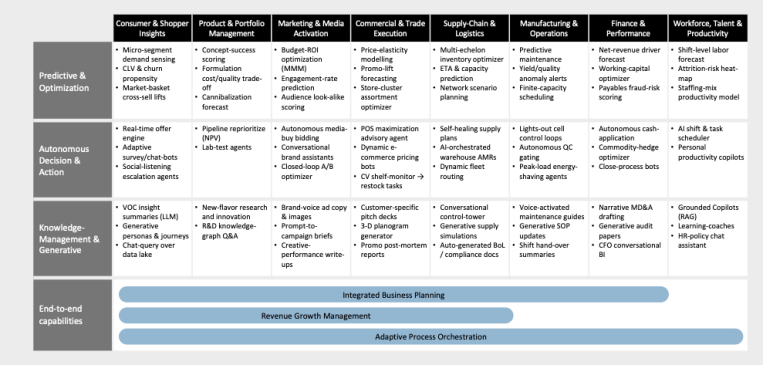
Illustrative opportunity matrix. Sanitized from project material to show structure, not content.

This structure, borrowed from a recent workshop, isn’t meant to be followed verbatim – it must be reframed based on each organization’s industry and AI posture, and paired with strategic pillars to give a full 360-degree view. It simply shows how to organize a portfolio around general concepts rather than specific technologies or use cases.

The Takeaway

AI opens unprecedented opportunities but is not a silver bullet. Pilots and use cases are necessary, but they are not sufficient. Like PCs, e-commerce, and mobile before it, AI’s real value will only come when organizations reinvent their structures to embed it deeply in business and operating models.

The winners won’t be those who run the most experiments. They will be the organizations willing to rewire themselves so that AI becomes part of the fabric of how business is done. For leaders, that means rolling up your sleeves and doing the hard job of transformation.


References

The impact of generative AI as a general-purpose technology
MIT Sloan School of Management, 2024
https://mitsloan.mit.edu/ideas-made-to-matter/impact-generative-ai-a-general-purpose-technology

Canaries in the Coal Mine? Six Facts about the Recent Employment Effects of Artificial Intelligence
Stanford Digital Economy Lab, 2025
https://digitaleconomy.stanford.edu/publications/canaries-in-the-coal-mine/

Evaluating the Impact of AI on the Labor Market: The Current State of Affairs
Yale Budget Lab, Yale University, 2025
https://budgetlab.yale.edu/research/evaluating-impact-ai-labor-market-current-state-affairs

One Year of Agentic AI: Six Lessons from the People Doing the Work
McKinsey & Company, 2024
https://www.mckinsey.com/capabilities/quantumblack/our-insights/one-year-of-agentic-ai-six-lessons-from-the-people-doing-the-work

The State of AI: How Organizations Are Rewiring to Capture Value
McKinsey & Company, 2025
https://www.mckinsey.com/capabilities/quantumblack/our-insights/the-state-of-ai

Why AI Will Not Provide Sustainable Competitive Advantage
MIT Sloan Management Review, 2025
https://sloanreview.mit.edu/article/why-ai-will-not-provide-sustainable-competitive-advantage/

How to Capitalize on Generative AI
Harvard Business Review, 2023
https://hbr.org/2023/11/how-to-capitalize-on-generative-ai

Why Robots Will Displace Managers – and Create Other Jobs
MIT Sloan Management Review, 2025
https://sloanreview.mit.edu/article/why-robots-will-displace-managers-and-create-other-jobs/

The Economic Potential of Generative AI: The Next Productivity Frontier
McKinsey & Company, 2023
https://www.mckinsey.com/capabilities/mckinsey-digital/our-insights/the-economic-potential-of-generative-ai-the-next-productivity-frontier
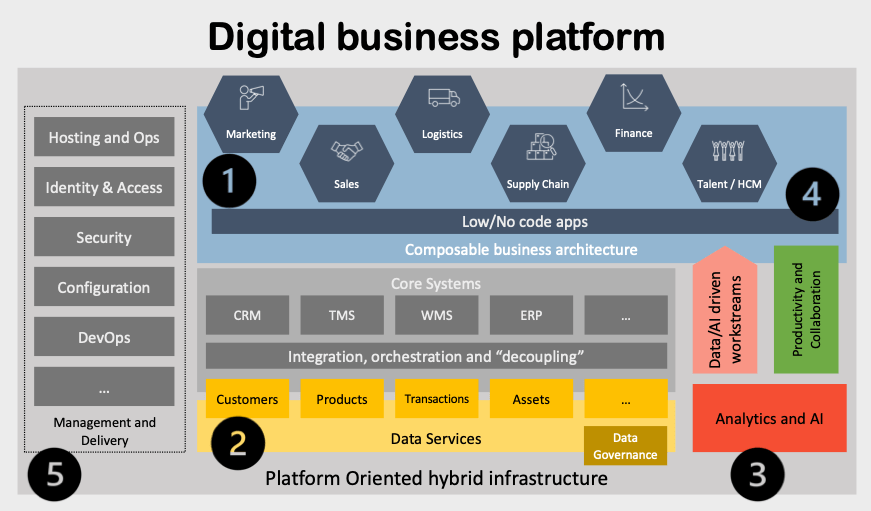
Digital Business Platform

Digital business platform

A Reference Architecture to Accelerate Digital Metabolism

Key Concepts

  • Why it matters: overcome technical rigidity to accelerate innovation and growth
  • Architecture + infrastructure: combines design and management for flexibility and agility
  • Composable business architecture: modular capabilities enable adaptable and flexible operations
  • Data services: unified, high-performance data store for master and operational data
  • Analytics and AI integration: real-time insights “loops” for data-driven operational workflows
  • Low/no-code platform: tools for rapid innovation through citizen-developed apps
  • Centralized management and DevOps: standardized provisioning and delivery across the platform
  • Technology selection: balance best-of-breed solutions with seamless interoperability for agility
  • Simplicity as a mindset: streamlined, standardized design enhances efficiency

Breaking Free from Legacy Architectures

All the organizations we’ve worked with over the past few years to develop or accelerate their digital strategies faced technical debt in their tech stack, the product of legacy architectures, amorphous cloud migrations and complex operations practices. This debt hampered their “digital metabolism”—the speed and agility with which they could innovate, adapt, and transform digitally.

Some signs of this debt are easy to spot: outdated legacy applications, siloed business processes, point-to-point integrations, and inaccessible or poor-quality data. Others are more subtle and require a more ambitious aim, like modern data governance, DevOps, and release management practices—capabilities that digital leaders have mastered. (As a side note: coming from the technology industry certainly helps some of us identify modern engineering practices that can be adapted and applied broadly.)

Technical debt slows down new projects, drives up costs, limits data accessibility and usability, and often results in makeshift attempts at digitization and automation. These fragmented approaches compound the “digital spaghetti” problem: a tangled clutter of overlapping processes, apps, technologies, and data flows. The result? Slower innovation, higher risks, and in some cases, stalled digital transformations.

Technical debt is expensive: according to McKinsey & Co., “Some 30 percent of CIOs we surveyed believe that more than 20 percent of their technical budget ostensibly dedicated to new products is diverted to resolving issues related to tech debt.”

For years, business and technical thought leaders have been sounding the alarm and proposing solutions, including composable architectures, planned cloud migration, application refactoring, and data modernization. Until recently, these ideas seemed futuristic or, at best, targeted efforts to address isolated problems.

The good news is that advances in off-the-shelf applications, cloud platforms, integration technologies, engineering practices and industry standards have made holistic solutions more achievable, with surprisingly lower costs and risks than before.

This article introduces the concept of a digital business platform, bridging the gap between a reference architecture and operations framework to help organizations approach the management of their technology ecosystem holistically to break free from innovation-limiting legacy infrastructures and address technical debt. These design and management principles –curated from real-world cases– provide a structured, methodical approach to building an agile, scalable infrastructure.

Key Components of a Digital Business Platform

1) Composable Business Architecture

At the core of the digital business platform is a modular grid of business capabilities (marketing, sales, production, logistics and the like) implemented in applications –or, in some cases, custom-built software– and wired together in macro-processes to support the desired business models, operating processes, customer journeys and employee experiences.

Gartner’s concept of composability is a robust framework for designing this architecture. Just a few years ago, implementing this approach was difficult for most organizations due to the limited modularity and flexibility of off-the-shelf solutions. Today, with the latest omnichannel, customer relationship management (CRM), supply chain, digital banking, and financial management solutions, composability is much more attainable and affordable.

To maximize flexibility, reusability, and long-term value, discrete business capabilities and connected end-to-end scenarios should be managed as digital products—designed for continuous evolution, adaptation and reuse across projects, businesses and geographies.

2) Data Services

In the client-server era, data architecture was relatively straightforward: data resided in centralized databases, neatly structured and managed to support business applications, maybe with a universal integration bus orchestrating flows and transactions. Analytics platforms accessed, processed and organized this data for visualization tools, advanced models for decision making and, in some cases, feed augmented insights into the centralized stores.

SaaS platforms changed all this, offering elasticity, lower costs of ownership, faster implementation, and reduced risk, but obscuring data management. Each platform usually comes with its own proprietary data structures.

This challenge can be addressed deploying a Data Service that meets both data and integration architecture needs. Data services can be assembled using various underlying technologies, and is designed to provide standardized data models, centralized governance and security, reusable interfaces, and robust data management – ensuring that data is handled with high performance and reliability.

Unlike data lakes or data warehouses, which are typically associated with analytics-focused architectures, a Data Service handles day-to-day business transactions and real-time integrations. In contrast to an integration bus that merely replicates data across systems, the Data Service maintains the reference version of each dataset as the authoritative source.

A data service must include or be integrated with a data governance solution to ensure visibility, consistency, compliance and ultimately high-quality data across all applications, enabling trusted, well-managed data for both operational and analytical use.

3) Analytics, AI, and Data-Driven Workstreams

A well-designed common data service can feed master and transactional data into advanced analytics and AI platforms via efficient data pipes and extract, transform and load (ETL) processes. Output from advanced analytics models featuring leading-edge data science and AI then loop back into business applications to enable data-driven workstreams —fully-automated or human-in-the-middle processes that respond to real-time insights.

Depending on the use case, technology stack, and performance requirements, this “data-driven loop” can be implemented using various architectures, from event-driven systems to data streaming.

4) Low/No-Code Platform

To extend the functionality of out-of-the-box applications and accelerate innovation, the digital business platform should prescribe a single low-code/no-code platform. These tools empower “citizen developers” to create small applications and workflows without deep technical expertise.

For easy adoption and maximum impact, these platforms should be structurally integrated with business applications, the common data service, and analytics tools. This set-up allows business users to quickly roll-out new business processes and leverage data driven insights at speed and scale, while maintaining alignment with IT standards.

5) Centralized Management, Provisioning, and Delivery

Agile IT delivery requires more than just a well-designed architecture—it depends equally on robust infrastructure management. While architecture defines how applications, data, and processes interact, infrastructure management ensures that these components are deployed, provided, and maintained efficiently.

A flexible digital platform operates within a hybrid hosting model, conceived to seamlessly manage workloads across cloud, on-premises, and edge environments. This flexibility allows case-specific optimization: leveraging the cloud for performance-intensive tasks, on-premises infrastructure for high-availability requirements, and secure edge zones with high-speed connectivity to support sensors, industrial controllers, and other IoT devices.

A standardized hosting model serves as an enabler of the organization’s cybersecurity strategy. As distributed hybrid infrastructures become the norm, the zero-trust security model has emerged as the predominant approach, requiring strict verification for every user, device, and service attempting to access resources. To be effective, zero-trust principles must be tightly aligned with the integration architecture, DevOps pipelines, and change management processes, ensuring that security is embedded at every stage of the design, engineering and deployment to support a robust DevSecOps program, where security is not an afterthought but an integral part of the platform’s lifecycle.

Normalized identity and access management services and policies improve user experience, accelerate adoption, enhance security, and reduce total cost of ownership.

Meanwhile, a common DevOps platform, synchronized release schedules and centralized configuration management streamline the orchestrated delivery of new features and updates across applications and infrastructure, increasing speed, productivity and simplifying change management. These delivery mechanisms should be harmonized with relevant transformation and IT “ways-of-working” like project management and Scrum.

This platform-based approach transforms the IT operations and support teams into a highly efficient internal “service provider,” offering a scalable and flexible infrastructure. By standardizing processes, tools, and delivery mechanisms, IT can seamlessly provision resources on demand and elastically support a diverse range of “internal customers” from project teams to entire business units.

Technology Selection

Choosing the right technology to build a digital business platform depends on the organization’s business context, application portfolio and digital strategy. Organizations that rely primarily on off-the-shelf SaaS or IaaS solutions focus on hosting, integration, and management technologies that support and interoperate with these platforms.

In contrast, organizations with a sizable number of custom-developed applications can adopt dynamic provisioning patterns such as virtualization, containerization, and infrastructure-as-code, enabling flexible, scalable, cost-effective deployments.

Selecting technologies to build a digital business platform requires an exquisite compromise between best-of-breed solutions and seamless interoperability. While best-of-breed technologies may offer specialized capabilities and advanced features, their integration into a broader ecosystem can introduce complexity, increased costs, and operational inefficiencies.

Prioritizing technologies that support integrated management is desirable, as this enables greater flexibility, agility, and cost-efficiency. An integrated and gradually automated infrastructure simplifies deployment, maintenance, and updates while ensuring streamlined processes and data flows across layers of the architecture.

Beyond TOGAF: Architecture Design and Infrastructure Management

A keen observer would reason that these principles reflect the TOGAF architecture framework, which also emphasizes modularity, interoperability, and alignment between business and IT, and addressed the same “layers”: business, data, applications, technology and governance.

The TOGAF framework –widely applicable in this context– certainly provides a strong foundation for architecture design. However, it often falls short or is too complex in addressing modern operational needs, such as hybrid hosting, DevOps practices, and streamlined resource provisioning in cloud environments – areas that expert practitioners might reasonably place within the technology or governance layers.

By embedding these management elements with simplicity, the digital business platform seamlessly extends TOGAF, enabling organizations to not only design scalable architectures but also implement them with speed, efficiency, and agility.

Simplicity to Manage Complexity

While extremely powerful in streamlining IT delivery, the digital business platform is –and must be approached as– a very simple concept: a set of architecture patterns and technology standards methodically adopted to enhance flexibility, scalability, and operational efficiency. It ensures that business processes, data services, and applications are modular, interconnected, and easily adaptable to evolving business needs.

By also envisioning and standardizing infrastructure management and delivery elements such as hosting, access control, and DevOps practices, it enables organizations to rapidly deploy solutions, optimize costs, and continuously innovate without being weighed down by technical rigidity.

Simplicity should be both a target and a mindset, guiding design and decision-making to create a streamlined, efficient ecosystem. When applied methodically and thoroughly, simplicity unlocks extraordinary long-term benefits. In most cases we’ve worked on, retroactive normalization and rationalization have resulted in less work for operations teams, not more.

Accelerating Digital Metabolism

The platform approach accelerates digital metabolism, enabling faster time-to-market for digitally enabled business innovations, enhanced data-driven decision-making, and continuous process improvements. Over time, it fosters a “digital-first” mindset by dispelling the myth of overwhelming technical complexity.

Implementing a modern digital business platform to manage technical debt is a strategic enabler of growth. As McKinsey & Co. notes, “Companies effectively managing technical debt experience revenue growth rates 20% higher than those with poor technical debt management.”

In the next article, we’ll present an example of a digital business platform implemented with actual technology components. In the third article, we’ll explore the organizational model necessary to support this architecture.


Further Reading

Tech debt: Reclaiming tech equity, McKinsey & Co.
https://www.mckinsey.com/capabilities/mckinsey-digital/our-insights/tech-debt-reclaiming-tech-equity

Digital acceleration is just a dream without a new approach to tech, Boston Consulting Group
https://www.bcg.com/publications/2020/how-to-successfully-accelerate-digital-transformation

Strategic Roadmap For The Composable Future Of Applications, Gartner, Inc.
https://www.gartner.com/en/doc/433984-2021-strategic-roadmap-for-the-composable-future-of-applications

Why You — Yes, You — Need Enterprise Architecture, MIT Sloan
https://sloanreview.mit.edu/article/why-you-yes-you-need-enterprise-architecture

How to build a data architecture to drive innovation—today and tomorrow, McKinsey & Co.
https://www.mckinsey.com/capabilities/mckinsey-digital/our-insights/how-to-build-a-data-architecture-to-drive-innovation-today-and-tomorrow

8 Steps for a High-Impact Enterprise Architecture Program, Gartner, Inc.
https://www.gartner.com/smarterwithgartner/8-steps-for-a-high-impact-enterprise-architecture-program

Agility@Scale: Solving the growth challenge in consumer packaged goods

Conducting research for a customer project I came across this paper.

The premise is that the reconfiguration of the US market has undermined traditional growth models for consumer-packaged-goods companies, particularly large ones.

The authors argue that there is no single solution to the growth challenge; rather, changes along multiple dimensions are necessary.

While not directly focused on digital innovation, the correlation between what growing consumer packaged goods companies are doing and the traits of digital leaders is astonishing:

  • Build an agile, streamlined organization
  • Develop triple-A capabilities: Advanced analytics and automation
  • Fuel growth through agile resource reallocation
  • Ditch the stage gate for ‘test and learn’ innovation
  • Reset customer collaboration: E-commerce and small format
  • Deliver next-generation consumer engagement: ‘Consumer 3.0’
  • Use Agility@Scale to go broader and smaller

Highly recommended reading for executives in consumer packaged goods companies revising their strategies to revitalize growth strategies.

Agility@Scale: Solving the growth challenge in consumer packaged goods
Jan Henrich, Ed Little, Anne Martinez, Kandarp Shah and Bernardo Sichel
McKinsey & Company, July 2018

Solving the digital and analytics scale-up challenge in consumer goods

McKinsey argues that consumer-goods companies have invested in digital and analytics, but that more than half of the time those investments have failed to yied the desired results.

Their research shows that only 40 percent of consumer-goods companies that have made digital and analytics investments are achieving returns above the cost of capital. The rest are stuck in what the authors call “pilot purgatory,” eking out small wins but failing to make an enterprise-wide impact.

But digital leaders are showing they way – with four core elements leading to digital and analytics success:

  • Set a bold long-term aspiration
  • Pursue ‘domain transformations,’ not unrelated use cases
  • Ensure the coherence of enablers across domains
  • Reconfigure your operating model for speed and flexibility

Solving the digital and analytics scale-up challenge in consumer goods
Ford Halbardier, Brian Henstorf; Robert Levin and Aldo Rosales
McKinsey & Company, 2020

Five major trends which will underpin another decade of digital innovation

EY surveyed senior leaders and executive management team members from 500 corporations and 70 start-ups across a range of global geographies and sectors, in order to pinpoint where they are on their transformation journeys, and where they are heading.

According to the research, today, almost half (44%) of corporate companies said they are making good progress with their transformation plans and are starting to embed them across their businesses. An additional 4% of corporates said they were even more advanced, with their transformation fully embedded and optimized across the organization. In two years’ time, two-thirds (66%) of corporates expect to be making good progress, and 17% expect their transformations will be fully embedded – demonstrating that they are on a steep transformation maturity curve.

But because transformation is a continuous cycle, it is never complete, and companies will need to continually evolve their programs to meet customers’ changing expectations.

EY identifies five major trends for the next decade of innovation:

  1. Cloud is the digital foundation
  2. Businesses are pivoting around data
  3. Experience is everything
  4. Ecosystems and partners help bridge the skills gap
  5. Security and privacy are soaring in importance

Five major trends which will underpin another decade of digital innovation
By
Jim Little
EY Global Microsoft Alliance Lead and EY Americas Technology Strategy Lead

Smart Strategies Require Smarter KPIs

Following-up on his 2018 article and self-assessment tool, Michael Schrage, a research fellow at the MIT Sloan School’s Initiative on the Digital Economy, explores how digital leaders are transforming the strategic role and purpose of key performance indicators.

Their research shows digitally sophisticated organizations have flipped traditional KPI purpose and processes inside out. Instead of seeing KPIs primarily as analytic outputs for humans, leading organizations increasingly use them as inputs for machines. Leaders rely on KPIs to train, tune, and optimize machine learning models for business impact.

Michael Schrage, “Smart Strategies Require Smarter KPIs
MIT Sloan Management Review, September 2019

Digital Business KPIs: Defining and Measuring Success

It’s time for enterprise CEOs, chief digital officers and CIOs to move beyond the transformation stage and set metrics and goals that lay out the digital business journey. This report describes the key performance indicators necessary to do so.

Digital business key performance indicators (KPIs) are designed to assess the degree of progress in becoming a digital business — which in turn leads to a change in performance that is reflected in the KPIs of the enterprise.

A first set of KPIs is required to assess the progress in digitalizing the current business model. It is possible for many areas such as sales, marketing, operations, supply chain, product/services and customer service to have digitalization goals and KPIs.

A second set of KPIs is required to assess the progress and opportunity of pursuing new digital business models. Growth, revenue, market share and margin metrics must clearly differentiate new revenue sources from nondigital ones

Digital Business KPIs: Defining and Measuring Success (Requires Subscription)
Analyst(s): Hung LeHong
03 March 2016

Leading With Next-Generation Key Performance Indicators

Michael Schrage, a research fellow at the MIT Sloan School’s Initiative on the Digital Economy and David Kiron, the executive editor of MIT Sloan Management Review, partnered with Google to run a survey of more than 3,200 senior executives and interviews with 18 executives and thought leaders, them to explain how they and their organizations are using KPIs in the digital era.

Then they went a step further and published a self-assessment tool to help leaders and their teams evaluate how they measure-up against those best practices.

Article
M. Schrage and D. Kiron, “Leading With Next-Generation Key Performance Indicators
MIT Sloan Management Review, June 2018

Self-Assessment Tool
Measure Your KPI Alignment
MIT Sloan Management Review, June 2018