There is a new version of this framework here
Academics, analysts and consultants have studied successful (and failed) Digital Transformation stories and while their proposed recipes differ, they point to four key ingredients to maximize the chances of succeeding: getting the strategy right, fostering suitable leadership and culture, assertively driving change and, of course, implementing successful technology empowered initiatives.
The framework presented here has been architected and tested to provide companies with an adaptable blueprint to design the strategy and the set of actions to implement it.
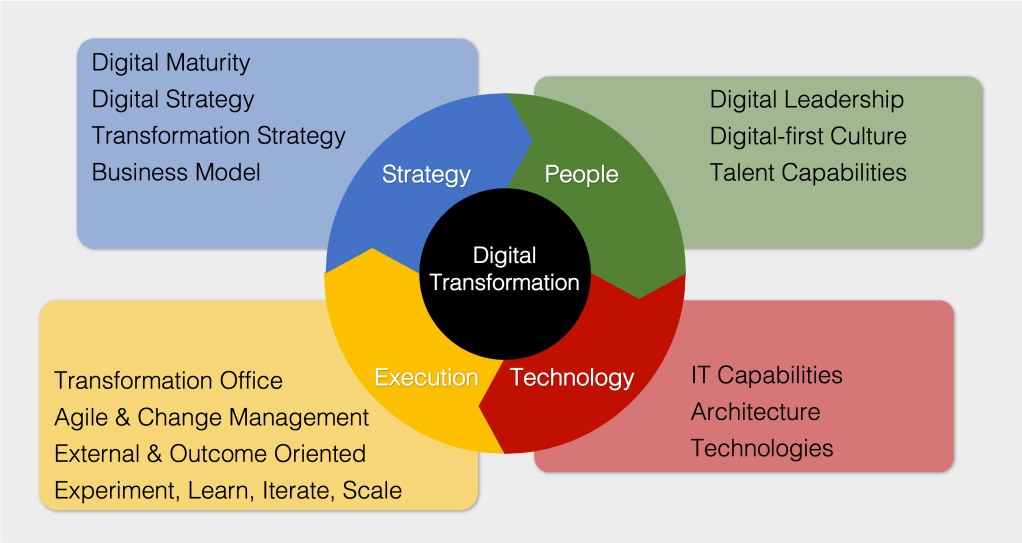
strategy
Digital Maturity

Digital Maturity defines how far along a company is in its digital journey. An assessment tool is used to determine the level of development of the different pillars of digital excellence: strategy, customer experience, data driven decision making, process automation, technology architecture and capabilities, etc.
The result is usually a compact but highly introspective diagnostic document describing in precise terms or even a numeric indicator where the company stands compared with best practices and, if available, industry averages.
Digital Strategy
The digital strategy defines how the business will be transformed using technology: finding, engaging and improving the experience of customers, making decisions, optimizing or automating processes, managing or enhancing the supply chain, etc. Good digital strategies will be built around “pillars” that will evolve very slowly, and initiatives prescribing shorter term changes with specific goals. In my experience, most digital strategies have a few common pillars (customer experience, data-driven decision making, process automation) and a few that are industry or case specific (IOT, industry 4.0, etc.)
The digital strategy will be informed and guided by the maturity assessment, industry trends, competitive pressures and the unique short- and long-term opportunities available and challenges threatening the business.
Transformation Strategy

The transformation strategy, tightly coupled to and a non-optional complement to the digital strategy, describes the structural changes needed to successfully implement it. Separating the two components is controversial, some purists will openly disagree with the idea, but in my experience formally developing the transformation component increases the chance of success by committing the leadership to the prescribed changes. Transformation strategies are also converging towards a standard formula: how to implement a transformation office, roll-out agile teams, set up an innovation or excellence hub, etc.
Business and Operating Models
Some but not all companies will need to reassess their business or operating models to gain the agility and flexibility required to innovate digitally. Traditional functional structures promote the silo mentality that slow or stall creative thinking, change, and some of the practices required to shine driving financial performance with technology, for example redesigning end-to-end customer experiences or data-driven revenue management. Digital leaders tend to assign responsibility for macro-process to the most applicable senior executives and instruct them to collaborate (read: negotiate) with their peers when the processes they own crosses organization lines. It takes time and a bit of conflict management to get started, but once the practice is accepted and results show up in the scorecards reluctance disappears quickly.
People
Digital leaders make their talent a strategic asset. They hire, motivate, train, and lead their people differently at all levels. It all starts in the leadership ranks.
Digital Leadership
Leading digital requires reformulating strategy, operating models and ruthless innovation, changes that rarely happen without involvement, incitement, and encouragement from the top. Alas, bringing the leadership on board is both the first critical step and the most challenging; senior leaders got there developing, establishing, and polishing the very same models they must now question and eventually leave behind.
Digital-first Culture

Further down the ranks, creating a digital-first culture and matching attitude requires widespread awareness of the digital strategy and enablement mechanisms including anchor initiatives, a reference digital architecture, strategic guidance and support from the innovation hub, agile experimentation, execution and change management methods, lots of training and unambiguous incentives.
Talent Capabilities
The talent (or human resources in classic parlance) organization will play a critical role in the transformation journey for which it should be drafted in early and determinedly. Some of the key contributions will be developing and hiring for the new functions and roles, including the innovation hub and the transformation office, updating competency toolkits, hiring practices, training, and evaluations with critical enabling skills like digital curiosity, Agile and change management, working with the CIO and CDO to reskill the IT organization, and more broadly modernizing leadership style and culture to embed the digital-first attitude.
Technology
Technology is of course the key enabler of all digital transformations, but the gaps, priorities and challenges may be counterintuitive. Most advanced technologies are quickly becoming virtually commoditized and therefore affordable thanks to Moore’s Law, relentless competition, massive investment, and accelerating adoption.
IT Capabilities

The real challenges most digitally non-native organizations will face are their technical competencies: lack of open and flexible architectures, data standards and governance, multi-speed project management practices, productized management of IT infrastructure and investments and customer focused (either internal or external) technical leadership.
Many companies are victims of their own success first adopting IT as an operational platform and then economically optimizing those capabilities and costs to maximize efficiency over the last three decades.
The main challenges will be reskilling the IT organization to engage with business teams to support innovation, reimagine the customer experience, empower citizen-developers and democratice access to self-service advanced analytics, and not necessarily implementing the technologies themselves, many of which they most likely already own but sub-utilize.
Execution
The last component in the framework, critical to bring all the investments to life and produce sustainable results, is impeccable execution.
Transformation Office
Assembling the pieces, orchestrating execution, and constantly looking out for strategic trembling, implementation gaps or barriers to change are the core responsibilities of the transformation office.
Agile and Change Management
Most organizations will need simple but vigorously implemented change management protocols to ensure that policies, processes, or legacy practices are mapped early, key stakeholders recruited, and risks assessed and accounted for.
Digital and Transformation KPIs

Very simple dashboards with KPIs, likely derived from the economic drivers supporting the original business cases, irrefutably measuring the implementation and results of digital initiatives and investments, and produced with good data governance, should become the single source of truth to track progress and impact.
Experiment, Learn, Iterate, Scale
The transformation journey is not a straight line. Courageous innovation requires experimentation and flexibility. Digital leaders combine an ambitious vision with restrained expectations. They prefer to under-promise and over-deliver. They have the flexibility to make mistakes, adjust, and iterate, but always plow ahead with unwavering conviction.
Getting Started
The framework may look overwhelming, but there is a logical sequence to start and move along, summarized below.
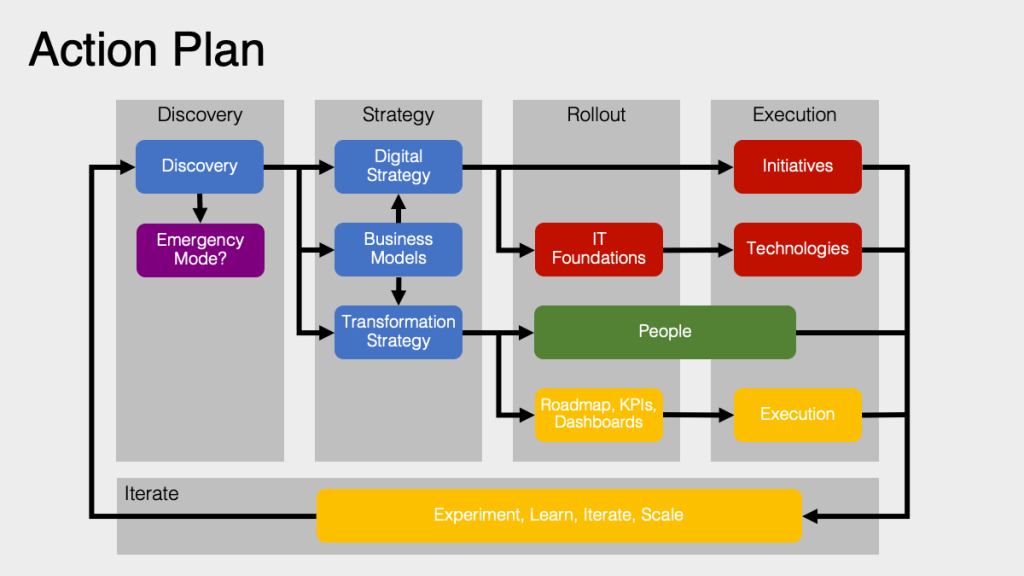
The digital maturity diagnostic will describe the starting point or “as-is” situation and feed the development of the (closely coupled) digital and transformation strategies, the desired “to-be”. The strategies will describe how innovation will be propelled by initiatives, the supporting technologies, and enabling capabilities – supported by business cases and measurable targets.
To overcome inertia and enable orchestrated execution, there is a growing portfolio of (by now mature) practices including Agile as an implementation and change management mechanic, organizational functions like innovation hubs and transformation offices, IT architectures and operating models, and traits of the required leadership style and a digital-first culture.
 Digital Transformation: A Framework