Key Concepts
- What has not changed: digital transformation remains business-driven, focused on value, not technology alone.
- What’s new: rethinking value delivery and customer journeys drives value; data, analytics, and AI grow in importance.
- Strategy and roadmap: clear, bold vision paired with actionable, incremental steps drives transformation success.
- Talent and leadership: transformation thrives on leadership involvement and workforce empowerment through upskilling.
- Business and operating model: reimagined processes deliver value through customer-centric, flexible, and scalable approaches.
- Digital business platform: composable architecture and agile infrastructure management enables agility through modular systems and seamless integration.
- Data, analytics, and AI: smart decision-making and growth rely on robust data governance and insights.
- Governance and execution: agile governance synchronizes initiatives, prioritizes impact, and ensures disciplined delivery.
- Everything must work together: holistic framework and integrated practices create synergy, transforming isolated efforts into unified value delivery.
- How to start: assess readiness, engage leadership, develop a bold vision, and prioritize milestones.
Since the last iteration of our digital transformation framework in 2019, the world has undergone significant and profound shifts. Working with numerous organizations across various industries and geographies, we have witnessed companies either thrive or struggle with their transformations as they simultaneously adapted to change and weathered unprecedented disruptions.
The COVID-19 pandemic, supply chain stresses, and rising inflation tested every aspect of business operations, forcing rapid adaptation. Simultaneously, accelerated cloud adoption, breakthroughs in AI, and heightened cybersecurity threats redefined both the opportunities and challenges in technology for businesses worldwide.
These developments encouraged a reevaluation and refinement of our framework, ensuring it remains relevant to today’s business environment, while retaining key principles that remain unchanged.
Core Principles: What Hasn’t Changed
The fundamentals remain intact. First and foremost, digital transformation is about business, not technology. The best digital strategies are business strategies that have been reimagined through the lens of emerging technologies. The focus must always be on how technology can disrupt or enhance business models, customer experiences, and operational processes to drive growth and value.
Leadership and talent continue to be key success factors. Digital strategy must be driven by the CEO and executive team to maximize speed, adoption, and overall impact. Leadership from the top ensures that digital transformation is treated as a strategic priority, rather than an IT initiative. When the entire C-suite is engaged, the organization can pivot swiftly, mobilize resources efficiently, and ensure that the transformation aligns with business aspirations and ultimately drives philosophical cultural change.
Structuring and scaling technology delivery capabilities continue to be critical enablers. An organization must be equipped with a robust, agile infrastructure that supports rapid experimentation, continuous iteration, and operational scaling. Without these delivery capabilities, even the most innovative digital strategies may fail to generate real impact.
Finally, execution is paramount. Success hinges on well-orchestrated execution, agile governance, and a relentless focus on delivering value. It’s about taking clever ideas and transforming them into meaningful customer value, motivated teams, and tangible financial results.
Evolving the Framework: Recent Learnings Incorporated
The updated framework has been restructured to integrate key learnings from recent years.
Business and operating models, including customer lifecycle and experience, are now grouped as a top-level component, emphasizing the importance of designing and managing these as foundational blueprints, outlining the value delivery model that underpins the architecture of a digitally transformed enterprise.
Another critical update is the elevation of data, analytics, and AI as one of the now six top-level components. Data has become an invaluable asset in today’s economy, driving smarter decision-making, optimizing execution, and creating competitive advantages. AI, with its boundless potential and enormous appetite for high-quality data, only accentuates the need for strong data governance, infrastructure, and analytics capabilities. These allow organizations to extract significant value from their data, giving them a competitive edge, and, ultimately, to unlock new growth opportunities.
The technology capability has been thoroughly updated to emphasize composable business architectures that support flexible operating models and processes. Platform-oriented, hybrid infrastructures, which integrate cloud hosted, SaaS, and on-premises solutions are now essential components of the modern technical stack. Carefully blending technical design and management processes are critical for enabling agility and scalability, supporting the organization’s transformation efforts with standardized and normalized delivery practices.
The Updated Digital Transformation Framework
Our experience implementing transformation initiatives across a range of industries and company sizes, combined with research from academics, experts, and global digital leaders, has underscored six critical components that are vital for successful digital transformations. These components remain crucial regardless of the specific industry or disruption potential.

Strategy and Roadmap: Charting the Digital Future
Digital transformations begin with a clear and compelling vision of how technology will reshape the business or even the broader industry. This vision must be more than just a lofty goal – it needs to be grounded in the specific ways that digital technologies can enable access to new markets, enhance customer experiences, and optimize operational efficiencies. Our experience shows that the most effective digital strategies are ambitious in the long term but paired with a realistic, actionable roadmap that balances bold innovation with pragmatic, incremental steps toward transformation.
Developing this roadmap requires collaborative creation between business leaders and newly integrated digital experts. The strategy must be business-owned and executive-led, as digital transformation touches every facet of the organization. When the vision is created and driven by those with a deep understanding of the business, the digital strategy becomes a natural extension of the company’s long-term aspirations. In practice, this means the CEO and executive team must take an active role in shaping and executing the digital agenda, ensuring that transformation efforts are aligned with long-term business objectives and resistance to change (often passive and sometimes pervasive) is quickly identified and addressed.
A concise, one-page vision is the most effective way to communicate the digital strategy across the organization. This vision can be represented in a matrix format, where the columns represent pillars – aligned with key strategic and operational drivers – and the rows connect specific initiatives to projects and the enabling capabilities needed to execute them. (See Anatomy of a Digital Strategy.) This simple visual approach helps leaders and teams alike see how each part of the strategy ties together, providing clarity and focus to guide decision-making and prioritization across the business, and ensuring that everyone in the organization understands their role in building the digital future.
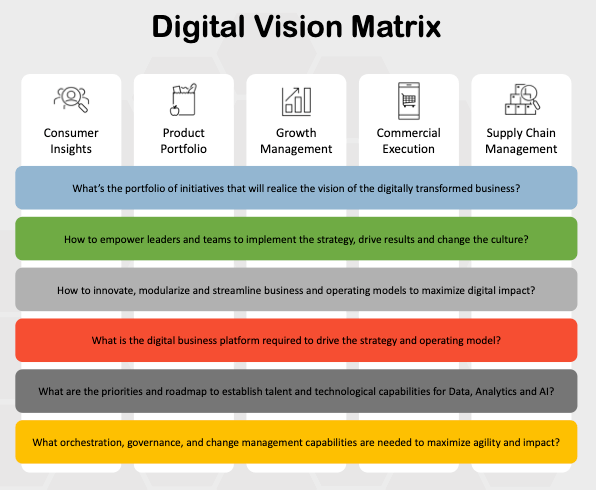
One of the key benefits of a well-structured strategy and roadmap is its ability to link high-level strategic objectives with financial targets. Most of the strategies we develop with our clients include specific financial goals, such as transformative improvements in unit economics (e.g., cost to acquire or serve customers, working capital intensity) and range targets for aggregate bottom-line impact. The connection between digital strategy and financial performance is critical for driving real, measurable value, while this level of rigor brings discipline to the investment process, ensuring that each initiative is focused on outcomes that matter.
A well-defined roadmap should prioritize initiatives based on impact, feasibility, and alignment with business goals. It is crucial to sequence digital initiatives in a way that maximizes momentum and ensures that early wins build confidence and support for longer-term efforts. For example, some initiatives may focus on quick operational improvements, while others may involve more complex changes to business models or customer experiences. Balancing these efforts ensures that the organization can achieve immediate benefits while laying the groundwork for more transformative, disruptive changes down the line.
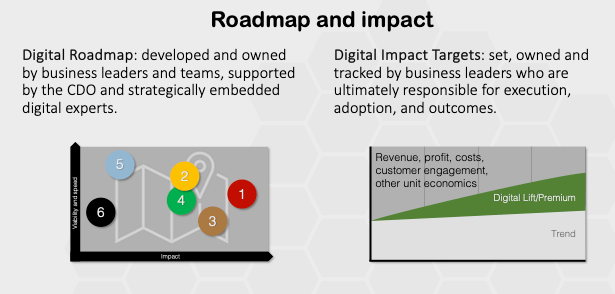
Every digital transformation strategy is a commitment to continuous evolution and not a single transition effort. The roadmap should not be static but must adapt as the organization progresses on its journey. New technologies, shifting market dynamics, and evolving customer expectations will require recalibrating the strategy over time. The core vision of a digital transformation is about more than just setting a direction – it is about starting an iterative, structured, disciplined approach to achieving meaningful and sustainable business impact through nonstop digital innovation.
Talent and Leadership: Driving Transformation with People at the Core
No matter how well-designed the strategy or how advanced the technology, transformation efforts will falter without the right people driving and executing the initiatives. Digital transformation is not just about changing processes and tools – it’s about rethinking the organizational culture, leadership structures, and the skills that are needed to succeed in an increasingly digital world.
At the front of this transformation is a leadership team committed to steering the organization toward its future state, supported by a workforce that is empowered, skilled, and aligned with the strategic goals.
Multiple studies have demonstrated that organizations where the CEO actively sponsors and drives the digital agenda are more likely to achieve success. Executive sponsorship sends a clear signal to the entire organization that digital transformation is a top priority. It ensures that the necessary resources, attention, and focus are given to the initiatives. Hands-on involvement from the executive committee is essential, with each member taking ownership of one or more of the static pillars and the key components of the transformation. This direct involvement ensures that the digital strategy is not seen as a siloed IT effort but is embedded in the DNA of the business.
Transformational leadership goes beyond simply supporting digital initiatives – it requires restructuring leadership roles and responsibilities to accelerate digital reinvention. Often, we work with leaders to reshuffle mid-level management ranks, moving away from siloed functions and integrating responsibility for end-to-end value streams, such as order-to-cash or procure-to-pay. These value streams cut across traditional departmental boundaries, empowering owners to design, implement and refine digitally modernized processes, deploy seamless customer experiences, streamline operations, and respond more quickly to market and customer demands.
In addition to leadership realignment, role redefinition is necessary across all levels of the organization. The responsibilities of strategic, managerial, and operational positions must be revisited to ensure that they are aligned with the needs of a digital-first business. Digital transformation requires new ways of working, including more cross-functional collaboration, faster decision-making, and a greater emphasis on innovation and experimentation. As such, traditional roles may need to be updated or even reimagined to meet the demands of the digital age. In many cases, this involves creating entirely new roles that did not exist before, such as data scientists, analytics translators, digital product owners, and customer journey designers.
To support this shift, employees must be equipped with the skills needed to thrive in this environment. Upskilling focuses on building digital fluency, ensuring that employees across the organization are comfortable with new tools, data-driven decision-making, and agile ways of working, preparing employees to take on new roles as the needs of the business evolve.
Technical skills alone are not enough. Soft skills such as adaptability, creativity, and a growth mindset are equally important. Digital innovation is inherently disruptive, and employees must be able to navigate ambiguity, embrace change, and experiment with new ideas. Leaders play a crucial role in fostering these attitudes by promoting a culture of continuous invention and learning, where employees feel empowered to challenge the status quo and contribute to the organization’s digital evolution.
One of the keys to accelerate change is identifying and promoting emerging talent to pivotal roles. In our experience, selecting up-and-coming stars at all levels of the organization is critical to driving change. We constantly witness – and abundant research supports casual observations – the difference that creativity, flexibility, and can-do attitude inject to transformation efforts. By nurturing and promoting this talent, organizations can organically build a fast-moving, entrepreneurial environment that is well-suited to the demands of digital transformation. Emerging leaders serve as champions of change, inspiring their peers and helping to embed a digital-first mindset across the organization. At the same time, measured attrition may be inevitable and even desirable to accelerate the transition – and in some special circumstances to phase out obsolete habits.
The result of this artfully designed and meticulously executed talent and leadership program is a culture that embraces change, encourages innovation, and places a premium on agility and customer-centricity. This requires a deliberate effort from leadership to model the desired behaviors and to foster an environment where experimentation and risk-taking are rewarded, while targeting specific cultural shifts, such as breaking down silos, promoting cross-functional collaboration, and encouraging continuous feedback and improvement.
Change management plays a critical role in embedding this culture. Digital innovation introduces significant alterations to the way people work, and resistance is natural – efficient organizations are designed for predictability and stability, not constant evolution. Effective change management techniques – for example, assigning Agile teams to test and refine new processes before they are rolled our broadly – help employees understand the reasons for change, preview the advantages, realize how it benefits them, and how they can contribute to the organizations and their own success.
Business and Operating Model: Reinventing Value Delivery
One of the most surprising challenges we’ve encountered in our work as consultants is that many business leaders struggle to envision what aspects of their business to transform. This hesitation is particularly evident in traditional industries, where the established ways of doing business can make it difficult to identify opportunities for digital innovation. This is precisely where the business and operating model component comes into play, serving as an effective drawing board to guide leaders through the envisioning processes, potentially enhanced by design-thinking or human-centered techniques.
The combination of business and operating models, customer lifecycles and experiences represent the core wiring of how an organization creates value and delivers it to customers. Even industry-shaping innovations by digital natives like Amazon, Netflix, and Uber – despite their groundbreaking nature – are ultimately rooted in traditional concepts like shopping, entertainment, and transportation. What sets them apart is their reimagining of these fundamental business and operating models to leverage digital capabilities.
While not every industry can be completely revolutionized in the same way, a methodical evaluation of how an organization delivers value to its customers is an obvious – and surprisingly infrequent – starting point. This approach helps leaders identify transformative changes that can be enabled by digital technology, whether through reinventing customer experiences, reshaping operational processes, or creating entirely new business models.
By bringing business and operating models into the digital strategy discussion, it becomes clear that small, incremental improvements will not be enough. Leaders need to challenge long-held assumptions and open their minds to the possibility of disrupting even their most entrenched paradigms. Only by doing so can they unlock the full potential of digital transformation and create a business that is truly future-proof.
Digital Business Platform
The Digital Business Platform is is a holistic framework that integrates architecture design, infrastructure management, and modern operational practices to enable businesses to innovate, scale, and adapt rapidly.
It goes beyond traditional IT systems by unifying modular business capabilities, common data services, and seamless application integration. By incorporating key elements such as hybrid hosting, DevOps processes, and data-driven workflows, the platform fosters flexibility, agility, and operational efficiency. It empowers organizations to break free from technical debt, streamline IT delivery, and continuously innovate, accelerating the “digital metabolism.”
At the heart of this platform is a composable business architecture, which allows an organization to flexibly structure its business architecture around modular, autonomous components that can be orchestrated and reconfigured as needed.
Gartner states that “a composable digital business applies the core principles of composability (modularity, autonomy, orchestration and discovery) to the foundations of its business architecture (the business model, enterprise operations and strategy) in order to master the risk of change and reach untapped business value.”
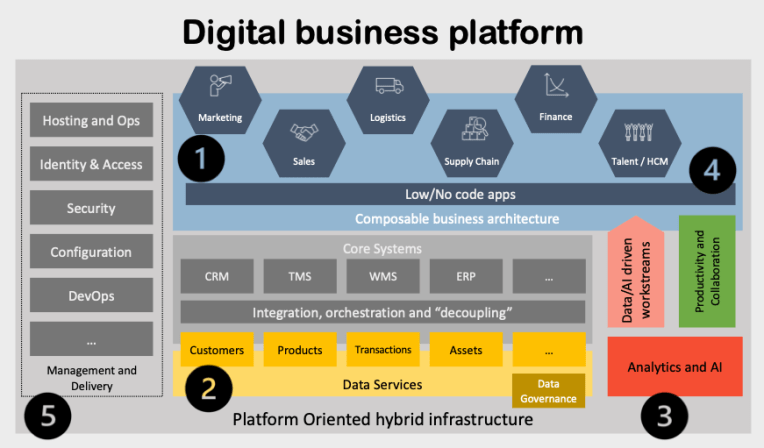
The key concept here is to structure the technical infrastructure around the core operational capabilities of the organization – such as customer management, order fulfillment, and product delivery – allowing these capabilities to be flexibly arranged within business processes. This flexibility makes it easier to adapt processes and workflows without requiring significant re-engineering or infrastructure changes, ultimately reducing time-to-market for new initiatives and improving operational efficiency.
One of the most critical advantages of a composable digital platform is its ability to facilitate rapid innovation. The COVID-19 pandemic offered a stark example of the power of modular architectures, as businesses with flexible technology stacks were able to quickly pivot to new customer engagement models. A notable example is the widespread adoption of contactless pick-up slots in retail parking lots – an innovation that became ubiquitous during the pandemic. Organizations with composable digital platforms were able to implement these new customer engagement models rapidly, maintaining continuity of service and even expanding their market share during a time of unprecedented disruption.
An essential approach underlying the implementation and management of the technology infrastructure is the platform oriented hybrid infrastructure, which should be designed to integrate and manage cloud, SaaS, and on-site infrastructures seamlessly. This hybrid approach ensures that organizations can leverage the benefits of cloud-based scalability and flexibility while maintaining control over critical on-premises systems.
The key to success with a digital business platform lies in centralizing management and standardizing processes across the platform. Delivery processes should be normalized and, ideally, designed as self-service systems that scale to support tens or even hundreds of Agile teams. While fully integrated and automated DevOps processes across cloud-hosted, SaaS, and on-site applications may be beyond reach for many organizations, a middle-ground approach can still deliver significant benefits. By adopting a unified project management tool, standardizing delivery, change control, and documentation practices, and implementing a federated product and release management framework, organizations can greatly streamline both individual projects and overall execution.
While a composable digital business platform is a medium-term goal, out most successful customers quickly take the first steps in this direction. Even if the current architecture is inflexible, integrations are cumbersome, and processes are highly manual, organizations can begin by restructuring their IT teams to function more like service providers. They start by consolidating and normalizing delivery processes, establishing Service Level Agreements (SLAs) to measure progress and transition to a fast, agile operating model.
Cybersecurity is another critical element of the digital business platform. As businesses adopt more interconnected architectures, new proactive cybersecurity strategies are needed. Traditional perimeter-based defense strategies have proven inadequate, particularly with the move toward hybrid and multi-cloud environments. Zero-trust has emerged as the new baseline security model, grounded on the assumption that threats can originate from both inside and outside the network, requiring continuous verification of user identities, device security, and application integrity. A good analogy for zero-trust is the way bank branches manage security: while there may be visible security guards, every employee and customer must use credentials to move between floors and access secure areas, and the most valuable assets – systems and data, in this analogy – are kept in secure vaults with additional layers of protection – in this case encryption and replication. Should a breach occur, silent alarms trigger automated mitigation processes to minimize damage and ensure business continuity.
A well-designed and managed digital business platform not only supports agility and innovation but also drives IT cost efficiencies. Long wait times and slow development cycles often stem from unnecessary work, much of which does not contribute to value.
Data, Analytics, and AI
Data has become one of the most valuable assets any organization can leverage, and its role in digital transformation cannot be overstated. The Data, Analytics, and AI (D&A) component of the framework focuses on building the capabilities necessary to harness data effectively for decision-making, integrating advanced analytics and AI into core business processes, and establishing strong governance frameworks to ensure data integrity and security.
As AI’s appetite for data continues to grow, having high-quality, well-governed data becomes even more critical. A robust data architecture, supported by effective governance, ensures that data products ranging from ubiquitous descriptive analytics dashboards to predictive AI and machine learning models producing insights that anticipate customer needs and market trends, can access the accurate and relevant data they need.

A holistic approach must be taken to the underlying data architecture for these capabilities to truly deliver value. The first step is to develop a precise understanding of where key data assets reside and how they are structured. Many organizations find themselves dealing with fragmented and siloed data that exists across legacy systems, cloud-based SaaS solutions, and modern advanced analytics platforms.
We often encounter organizations without an updated blueprint of these data assets, and their attempts to leverage AI or advanced analytics are inevitably hindered by inefficiencies, inaccuracies, or data quality issues. Therefore, an organized, methodical approach to data architecture is essential to ensure that all data assets – regardless of their origin – are properly integrated and structured to work seamlessly together.
This structured and methodical approach is especially critical when integrating multiple generations of systems that must not only coexist but also perform together as a unified whole. Data from various sources must be normalized, harmonized, and accessible to enable the coveted data driven decision making and action the leaders demand.
Matching technical data management capabilities, organizations need a broad, centrally orchestrated, federated, but lean and practical data governance program. It must be business-led and value-oriented, ensuring that the governance of data is not merely an IT exercise but an integral part of the strategic and operational processes. A successful data governance program enables organizations to manage their data assets effectively, maximizing data quality while balancing data-driven innovation with risk mitigation and compliance. The federated approach allows distributed teams to retain agility and autonomy, while central orchestration ensures standardized data management.
While the specifics can vary significantly between organizations, most will need to invest effort in designing and implementing a Data & Analytics (D&A) operating or delivery model. This model should define how centralized (e.g., centers of excellence, data architecture, or data science) teams develop and manage a unified strategy and command the creation, growth and sucess of distributed teams across business, functional, or geographic units.
Governance and Execution
Successful digital strategies require robust governance practices, starting with an effective execution system – an established process for driving initiatives from conception to completion.
Organizations with strong strategic execution capabilities can seamlessly integrate digital strategy into the ongoing management cycle, breaking down digital disruption into actionable steps to track progress and deliver measurable value. When digital priorities are incorporated into core strategy-setting processes, they become part of the organization’s natural execution rhythm, enabling the company to effectively manage change and maximize the value of digital initiatives. In our experience, organizations that are structurally well-managed – those that make sound strategic decisions and systematically track implementation and impact – are best positioned to embrace digital disruption.
The implementation of Agile (essentially a flexible, iterative project management approach focused on collaboration, organic change management, continuous improvement, and delivering incremental value efficiently) is the accepted standard in digital transformation. Agile and its project governance practices emphasize team empowerment, rapid iteration, continuous feedback, and flexible decision-making, which are essential for managing the fast-paced execution and real-time learning of digital initiatives. A portfolio management process must be established to synchronize, orchestrate and prioritize digital projects within the context of the company’s overall strategy, ensuring that resources are allocated to the most impactful initiatives.
To enable effective governance, a transformation office can be established to act as the central “control tower” for overseeing digital initiatives. This usually small ensures that all parts of the organization are moving in unison toward the shared digital vision, coordinating efforts across departments, and removing any roadblocks that could hinder progress. The transformation office usually co-designs many of the instruments underpinning the execution of the digital strategy, quickly shifting ownership to business leaders and teams.
Finally, a digital dashboard and KPIs serve as the single source of truth for tracking progress, adoption, and impact. This dashboard consolidates metrics across business and digital initiatives, providing leadership with real-time visibility into how digital projects are progressing relative to strategic goals. This not only enables more informed decision-making but also helps maintain momentum and accountability across the organization.
Seamless Integration of Components: A Unified Approach to Digital Transformation
For a digital transformation to succeed, the individual moving parts must be designed to connect seamlessly and work in harmony. Each component – whether it’s technology infrastructure, governance, data management, or business and operating models – must be integrated into a cohesive system that functions as a whole. Siloed efforts will fall short of achieving the transformation’s full potential, as value creation comes from the synergy of these interconnected elements.
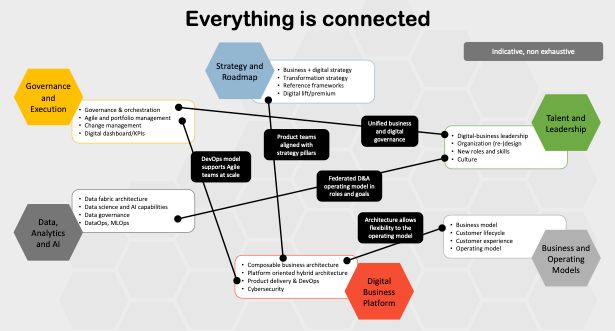
One example is the connection between the digital business platform and the processes supporting Agile teams. Delivery processes and structural functions like DevOps and Architecture are essential design elements of the infrastructure, and their design must match the internal workings of the Agile teams responsible for implementing digital products. DevOps becomes more than just an IT function; it establishes a rhythm that powers the rapid development, deployment, and scaling of digital solutions.
Similarly, the business and operating model – which includes the customer lifecycle, customer experience, and value delivery – must be tightly integrated with the development and management of the composable architecture. The composable architecture allows businesses to break down processes and operations into modular components that can be reconfigured to meet changing business needs. This flexibility must mirror how business teams design and adapt processes, ensuring that customer needs and value propositions are implemented in day-to-day operations by means of the digital architecture. Technology becomes the business.
Achieving this seamless integration is no small task. It requires a universal digital-first approach, pervasive cross-functional collaboration, alignment of goals, and a shared understanding of how each component fits into the larger transformation strategy. This is where the Chief Digital Officer (CDO), supported by the transformation office, come into play. These leaders and teams act as directors of a finely tuned orchestra, ensuring that all the moving parts of the transformation are working in concert.
Ultimately, the success of a digital transformation depends not only on the strength of each individual component but also on the ability of these components to connect and work together effectively. When properly aligned and integrated, the entire framework functions as a unified system, driving agility, innovation, and value creation across the enterprise.
How to start
To kickstart your digital transformation, it’s essential to first assess your organization’s digital readiness. This will help identify existing strengths and gaps, providing a clear understanding of where digital efforts will be most impactful. Engaging leadership early on is crucial, as their alignment and support will drive the transformation agenda and ensure strategic focus.
Next, develop a bold, forward-looking vision that challenges the status quo and encourages innovation. Pair this vision with a realistic roadmap that sets long-term goals while ensuring steady progress with achievable short-term milestones to maintain momentum.
Starting—or restarting—your digital transformation journey, especially if your current efforts are lagging or failing to meet targets, is both a challenge and an opportunity. It demands bold leadership, a clear vision, and a commitment to ongoing progress. While the path may be tough, the rewards are substantial: unlocking new growth, boosting competitiveness, and future-proofing your business. By embracing the challenges and moving forward with a strong strategy, your organization can turn obstacles into opportunities and thrive in the digital era, securing long-term success.
 Digital Transformation: A Framework