Overview
Digital transformation is no longer about technology. Most organizations — and their leadership teams — understand that. Digital is already part of their strategic ambitions and investment plans. What’s proving difficult is making it work as an effective program: one that links strategic priorities to initiatives, capabilities, and practices that deliver results.
This engagement helps boards and leadership teams answer some critical questions: How clearly are strategic priorities linked to digital initiatives? Is the business in charge and accountable? Are we investing in the right capabilities? Do our technology and delivery practices facilitate execution?
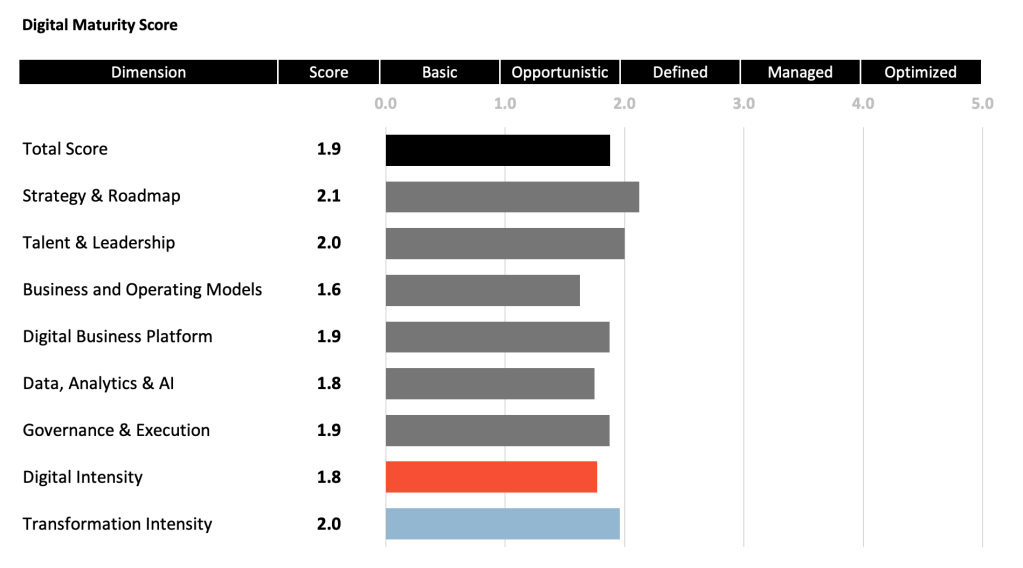
The Digital Maturity Assessment applies the six dimensions of the Digital Strategy Framework — strategy and roadmap, operating model, data and AI, platforms, leadership, and governance — to evaluate how effectively digital ambition is supported by execution. It shows where strength in one dimension is limited by weakness in another, and how integration across them drives value creation.
It measures both digital intensity — how broadly technology is deployed across the business — and change intensity — how deeply it contributes to value creation, customer experience, and operating processes.
Together, these perspectives explain where investment is translating into impact and where it is not. The outcome is clarity on what must change to maximize performance and return on digital investment (RODI).
What It Delivers
The assessment provides a factual view of digital maturity and its implications for value creation:
- Maturity profile – across the six dimensions of the Digital Strategy Framework
- Sub-scores – for digital intensity and transformation (change) intensity
- Heatmap and benchmarks – showing relative strengths, gaps, and progress over time
- Themes and insights – from interviews and evidence review
- Priority areas – that guide leadership focus and investment
How It Works
The process combines structured analysis with leadership discussion to link findings to decisions to action:
- Scope – confirm purpose, coverage, and dimensions to assess
- Collect – combine interviews, surveys, visits and supporting material
- Synthesize – consolidate findings and define maturity per dimension
- Align – review results and validate priorities
- Integrate – use outputs to inform strategy, roadmap, or governance design
Each stage can be scaled from a light diagnostic to a full organization-wide review.
Guiding Principles
Assessing maturity is not about scoring — it’s about alignment and learning. The value lies in understanding what’s working, what isn’t, and what to adjust to accelerate progress:
- Clarity over precision – insight matters more than numerical detail
- Relative progress – maturity is judged against ambition, not generic benchmarks
- Action over measurement – the goal is to drive change, not compliance
- Context first – industry, size, and complexity define what good looks like
- Consistency over time – repeat periodically to track progress and sustain direction
Effort and Format
- Duration: typically 3–6 weeks
- Format: modular — from interviews and targeted analysis to full survey, site visits and alignment workshop
- Deliverables: maturity profile, sub-scores, heatmap, summary report, and action priorities
- Use scenarios:
- Stand-alone diagnostic or benchmark
- Input to Digital, D&A, or AI strategy engagements
- Framework element within transformation playbooks for ongoing tracking
Extensions
The Digital Maturity Assessment is designed to work as part of broader strategy and transformation efforts, providing the evidence base for prioritization, program design, and investment decisions. It can also be used independently — to validate progress, refresh a baseline, or calibrate urgency before the next iteration of strategic execution.
- Digital Strategy – establishes the baseline for roadmap design
- Data, Analytics & AI Strategy – readiness input for capability planning
- AI Posture & Roadmap – alignment of ambition with data and governance
 Digital Transformation: A Framework