Digital technologies are disrupting organizations of every size and shape, leaving managers scrambling to find a technology fix that will help their organizations compete. This book offers managers and business leaders a guide for surviving digital disruptions―but it is not a book about technology. It is about the organizational changes required to harness the power of technology. The authors argue that digital disruption is primarily about people and that effective digital transformation involves changes to organizational dynamics and how work gets done. A focus only on selecting and implementing the right digital technologies is not likely to lead to success. The best way to respond to digital disruption is by changing the company culture to be more agile, risk tolerant, and experimental.
The Technology Fallacy: How People Are the Real Key to Digital Transformation By Gerald C. Kane, Anh Nguyen Phillips, Jonathan R. Copulsky and Garth R. Andrus
Digital Maturity indicates the relative development of a company and organization’s competency in key areas to establish present-day standing and help identify opportunities for improvement and priorities for investment.
This is usually accomplished running a Digital Maturity Diagnostic to determine whether an organization is lagging, competitive or leading based on a set of factors: e.g. Digital Strategy, Leadership and Culture, Digital Skills, Customer Centricity, Technical Competencies, Data & Data Analytics, Project Delivery, etc.
Academic researchers and consulting outfits have developed the models, and then applied them to large pools of organizations to determine relative maturity by company, sector, geography, etc. Many provide a set of results by category and a combined score.
Digital Maturity Reports are enormously useful tools to help business executives map where they stand in the innovation race relative to their peers, identify gaps and opportunities, throttle investment, and track progress along the digital journeys.
Generative AI arrived quickly, with bold promises dominating headlines. But anyone who has lived through past technology shifts knows the real story: the hard job of driving value is not proving it can work –…
Digital intensity and transformation management intensity influence revenue growth and profitability in different ways. This toolbox equips leaders to integrate superb transformational execution with their digital strategy, enabling them to achieve up to 26% greater…
The team behind The Digital Advantage: How Digital Leaders Outperform their Peers in Every Industry and The Nine Elements of Digital Transformation reflected on their influential research after surveying 1300 executives in more than 750…
Most business executives think – often reflected by who they bring to the room when you discuss the topic with a CEO – that Digital Transformation is about technology. It is not. Certainly, top notch…
Digital Maturity indicates the relative development of a company and organization’s competency in key areas to establish present-day standing and help identify opportunities for improvement and priorities for investment. This is usually accomplished running a…
Written six years ago, the robust analytical groundwork makes this paper a good read today. Furthermore, many of the recommendations are mainstream strategic plays in present-day toolboxes.
After outlining realities and challenges and how that game has changed, the authors argue that CPG companies should quicky move beyond establishing a digital presence—a website, some digital advertising, a presence in social media—and fully integrate digital into their operating model, build a big-data analytical capability, pursue a multichannel (or omnichannel) strategy, or tailor their product offerings to the digital or e-commerce marketplace
Their recipe to Playing the New Game to Win:
Develop an integrated strategy
Build brand equity online
Revisit category management across channels
Partner with retailers
Rethink supply chain configuration
Test, learn, scale
Build an adaptive organization
Manage internal tensions
Retrospectively, a missing item in this top-level list is advanced Data Analytics.
At a time when our research reveals that just 16 percent of executives say their company’s digital transformations are succeeding, companies we have worked with over the past three years using the Digital Factory (DF) model have been able to:
bring products to market faster (in six months versus two years)
do more with existing resources (eight product launches per year versus one or two)
create dramatically reimagined experiences (opening an account in five minutes versus ten days)
reduce tech development costs by a third (fewer managers per engineer)
attract the great talent required to compete in a digital world
We see reductions in management overhead of 50 percent for technology teams in the DF, 70 percent in the number of business analysts needed to write technology requirements, and, as test automation becomes the norm, a drop of 90 percent in the number of testers.
Abstract: For most mature companies, operational complexity, rather than lack of strategic thinking, will limit their ability to compete digitally. They result from years of new operational and commercial processes built next to (and on top of) legacy systems and ways of working.
This kind of organic evolution has made many companies too complex to adopt digital solutions. To compete digitally, business leaders must attack that complexity.
Conducting research for a customer project I came across this paper.
The premise is that the reconfiguration of the US market has undermined traditional growth models for consumer-packaged-goods companies, particularly large ones.
The authors argue that there is no single solution to the growth challenge; rather, changes along multiple dimensions are necessary.
While not directly focused on digital innovation, the correlation between what growing consumer packaged goods companies are doing and the traits of digital leaders is astonishing:
Build an agile, streamlined organization
Develop triple-A capabilities: Advanced analytics and automation
Fuel growth through agile resource reallocation
Ditch the stage gate for ‘test and learn’ innovation
Reset customer collaboration: E-commerce and small format
McKinsey argues that consumer-goods companies have invested in digital and analytics, but that more than half of the time those investments have failed to yied the desired results.
Their research shows that only 40 percent of consumer-goods companies that have made digital and analytics investments are achieving returns above the cost of capital. The rest are stuck in what the authors call “pilot purgatory,” eking out small wins but failing to make an enterprise-wide impact.
But digital leaders are showing they way – with four core elements leading to digital and analytics success:
Set a bold long-term aspiration
Pursue ‘domain transformations,’ not unrelated use cases
Ensure the coherence of enablers across domains
Reconfigure your operating model for speed and flexibility
Companies investing more in new technology make more money.
Research finds that companies that excel at digital transformation share six habits. Digital transformation leaders that exhibit these six habits enjoy better financial performance than companies that have yet to adopt them.
To catch up, the rest of the pack should learn from the digital transformation leaders who are:
Focusing on customers first and foremost
Accelerating AI to drive growth
Driving innovation through ecosystems and partnerships
Nurturing talent with new incentives and strategies
Activating governance plans for emerging tech
Powering innovation by leveraging data and being agile
Six habits of digital transformation leaders By Jim Little EY Global Microsoft Alliance Lead and EY Americas Technology Strategy Lead Savi Thethi EY Americas Consulting Services Technology Transformation Leader
EY surveyed senior leaders and executive management team members from 500 corporations and 70 start-ups across a range of global geographies and sectors, in order to pinpoint where they are on their transformation journeys, and where they are heading.
According to the research, today, almost half (44%) of corporate companies said they are making good progress with their transformation plans and are starting to embed them across their businesses. An additional 4% of corporates said they were even more advanced, with their transformation fully embedded and optimized across the organization. In two years’ time, two-thirds (66%) of corporates expect to be making good progress, and 17% expect their transformations will be fully embedded – demonstrating that they are on a steep transformation maturity curve.
But because transformation is a continuous cycle, it is never complete, and companies will need to continually evolve their programs to meet customers’ changing expectations.
EY identifies five major trends for the next decade of innovation:
Cloud is the digital foundation
Businesses are pivoting around data
Experience is everything
Ecosystems and partners help bridge the skills gap


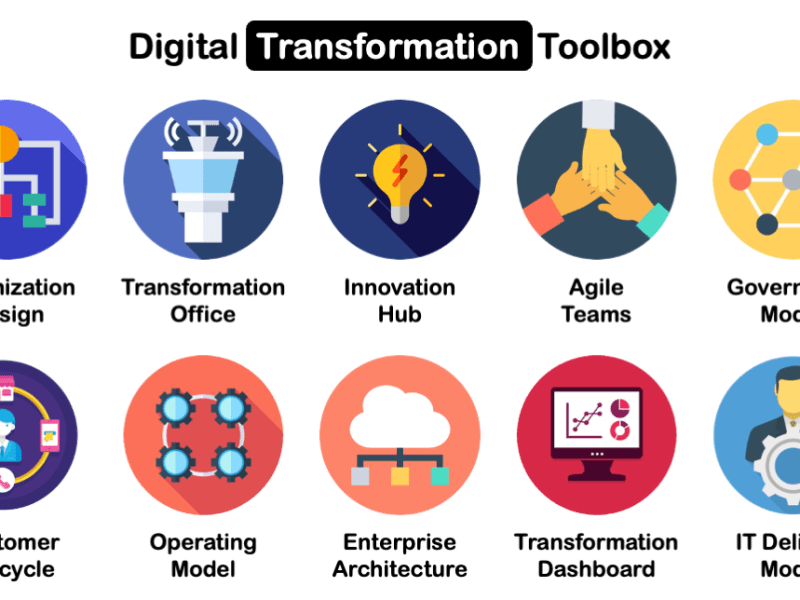



 Digital Transformation: A Framework