AI Posture & Roadmap
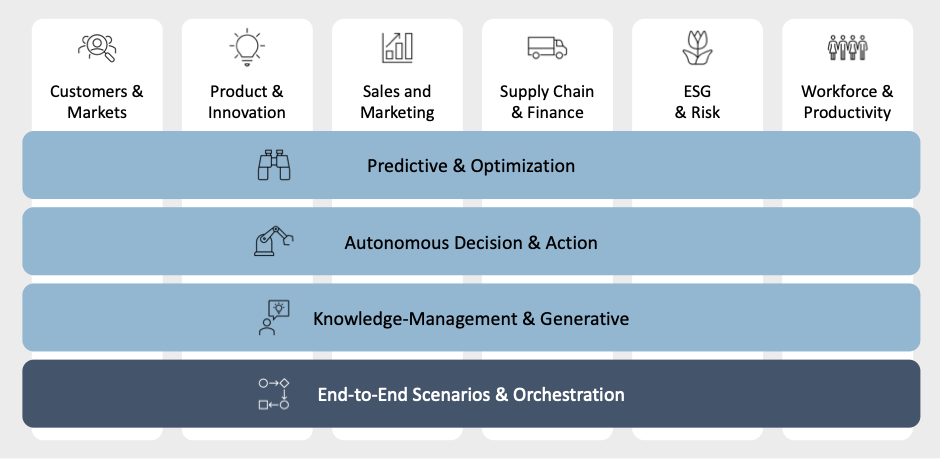
Overview AI is finding its place in business, but impact remains elusive. Most organizations are testing ideas, yet few have successfully linked them to how value is created – in cost, growth, or innovation. The issue is not the technology itself, but how it fits into the value proposition, business design, and decision processes. This engagement helps leadership teams confront those choices and answer a few practical questions: The work translates those questions into a structured AI portfolio – which initiatives improve efficiency, which drive growth, and which open new forms of advantage. It also defines what’s required to operate…
➔
Data, Analytics & AI Strategy
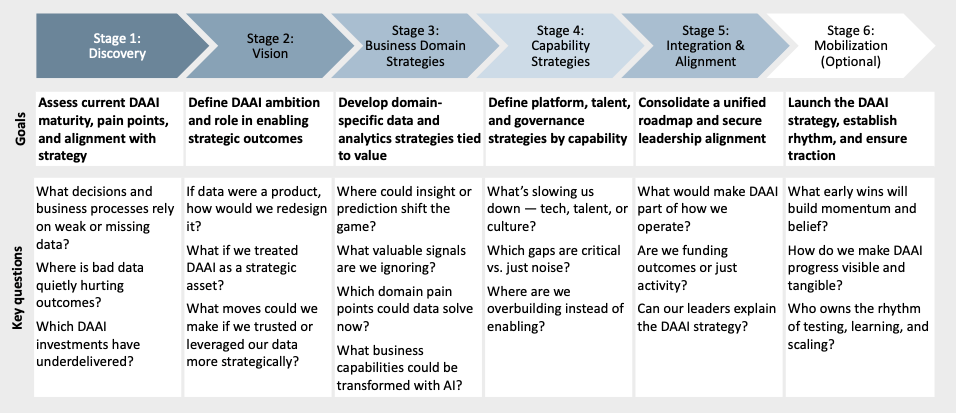
Businesses generate large volumes of data and experiment with AI. The real challenge is translating their potential into performance — embedding insight, prediction, and automation into how the business operates every day. This engagement helps leadership teams define how data and AI create business advantage: where they can change performance, what capabilities are required, and how to organize for sustained impact. It connects data architecture, analytics, and AI with business priorities and operating models — creating a single view of direction, investment, and governance. The work builds on the Digital Strategy Framework, deepening two of its core dimensions — Data…
➔
The Hard Job of Driving Value from AI
Generative AI arrived quickly, with bold promises dominating headlines. But anyone who has lived through past technology shifts knows the real story: the hard job of driving value is not proving it can work – it is adopting it to transform how companies work. Just as with PCs, e-commerce, or mobile, impact will not be fast or easy. Customers, colleagues, and friends — nearly everyone I exchange perspectives with is already using GenAI to work faster, smarter, and better. That matches findings from a recent paper by Andrew McAfee and colleagues, which shows the technology delivering rapid productivity gains across…
➔
Building a Digital Business Platform with Microsoft Tech
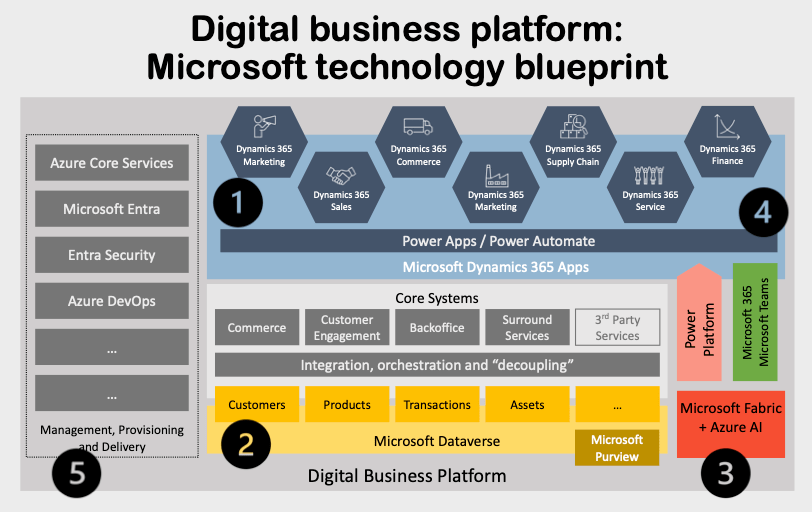
Microsoft’s digital business platform vision integrates modular applications, flexible infrastructure, and AI technology. Key components include Dynamics 365 for composable architecture, Dataverse for unified data services, and Microsoft Fabric for analytics. Power Platform enables low-code development, supporting scalable and compliant solutions within a vendor-neutral ecosystem, including integration with SAP systems.
➔
Digital Business Platform
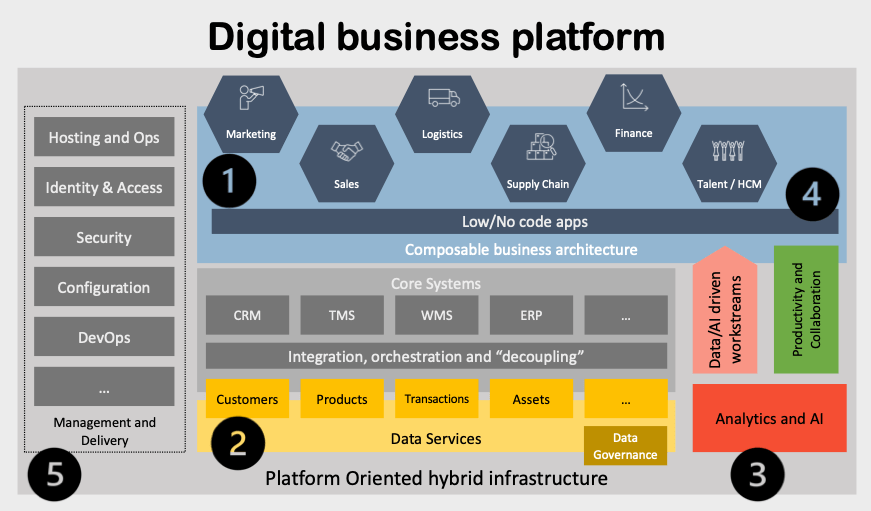
Legacy architectures and technical debt slow digital transformation, increase costs, and hinder agility. A Digital Business Platform addresses these challenges by integrating composable business architectures, common data services, AI-driven analytics, and centralized DevOps. This platform-oriented approach accelerates innovation, simplifies IT management, and enables scalable, secure, and efficient digital operations for modern enterprises.
➔ Digital Transformation: A Framework