A Reference Architecture to Accelerate Digital Metabolism
Key Concepts
- Why it matters: overcome technical rigidity to accelerate innovation and growth
- Architecture + infrastructure: combines design and management for flexibility and agility
- Composable business architecture: modular capabilities enable adaptable and flexible operations
- Data services: unified, high-performance data store for master and operational data
- Analytics and AI integration: real-time insights “loops” for data-driven operational workflows
- Low/no-code platform: tools for rapid innovation through citizen-developed apps
- Centralized management and DevOps: standardized provisioning and delivery across the platform
- Technology selection: balance best-of-breed solutions with seamless interoperability for agility
- Simplicity as a mindset: streamlined, standardized design enhances efficiency
Breaking Free from Legacy Architectures
All the organizations we’ve worked with over the past few years to develop or accelerate their digital strategies faced technical debt in their tech stack, the product of legacy architectures, amorphous cloud migrations and complex operations practices. This debt hampered their “digital metabolism”—the speed and agility with which they could innovate, adapt, and transform digitally.
Some signs of this debt are easy to spot: outdated legacy applications, siloed business processes, point-to-point integrations, and inaccessible or poor-quality data. Others are more subtle and require a more ambitious aim, like modern data governance, DevOps, and release management practices—capabilities that digital leaders have mastered. (As a side note: coming from the technology industry certainly helps some of us identify modern engineering practices that can be adapted and applied broadly.)
Technical debt slows down new projects, drives up costs, limits data accessibility and usability, and often results in makeshift attempts at digitization and automation. These fragmented approaches compound the “digital spaghetti” problem: a tangled clutter of overlapping processes, apps, technologies, and data flows. The result? Slower innovation, higher risks, and in some cases, stalled digital transformations.
Technical debt is expensive: according to McKinsey & Co., “Some 30 percent of CIOs we surveyed believe that more than 20 percent of their technical budget ostensibly dedicated to new products is diverted to resolving issues related to tech debt.”
For years, business and technical thought leaders have been sounding the alarm and proposing solutions, including composable architectures, planned cloud migration, application refactoring, and data modernization. Until recently, these ideas seemed futuristic or, at best, targeted efforts to address isolated problems.
The good news is that advances in off-the-shelf applications, cloud platforms, integration technologies, engineering practices and industry standards have made holistic solutions more achievable, with surprisingly lower costs and risks than before.
This article introduces the concept of a digital business platform, bridging the gap between a reference architecture and operations framework to help organizations approach the management of their technology ecosystem holistically to break free from innovation-limiting legacy infrastructures and address technical debt. These design and management principles –curated from real-world cases– provide a structured, methodical approach to building an agile, scalable infrastructure.
Key Components of a Digital Business Platform
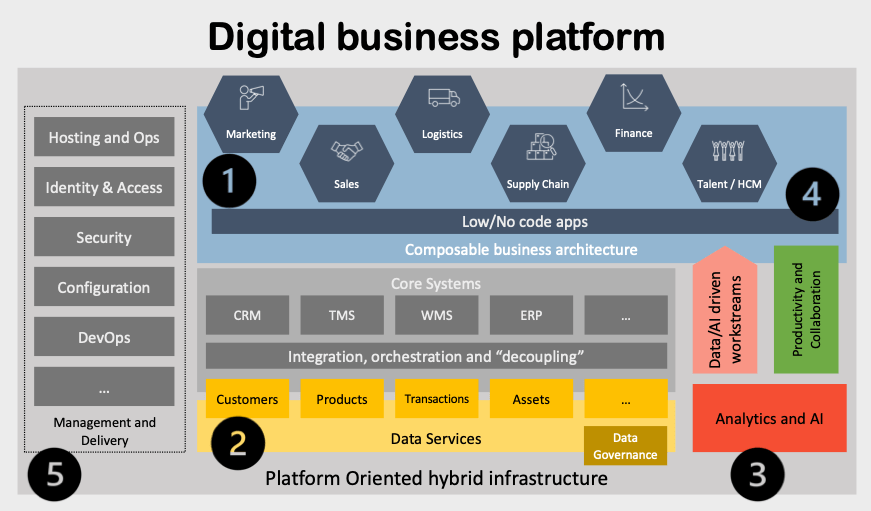
1) Composable Business Architecture
At the core of the digital business platform is a modular grid of business capabilities (marketing, sales, production, logistics and the like) implemented in applications –or, in some cases, custom-built software– and wired together in macro-processes to support the desired business models, operating processes, customer journeys and employee experiences.
Gartner’s concept of composability is a robust framework for designing this architecture. Just a few years ago, implementing this approach was difficult for most organizations due to the limited modularity and flexibility of off-the-shelf solutions. Today, with the latest omnichannel, customer relationship management (CRM), supply chain, digital banking, and financial management solutions, composability is much more attainable and affordable.
To maximize flexibility, reusability, and long-term value, discrete business capabilities and connected end-to-end scenarios should be managed as digital products—designed for continuous evolution, adaptation and reuse across projects, businesses and geographies.
2) Data Services
In the client-server era, data architecture was relatively straightforward: data resided in centralized databases, neatly structured and managed to support business applications, maybe with a universal integration bus orchestrating flows and transactions. Analytics platforms accessed, processed and organized this data for visualization tools, advanced models for decision making and, in some cases, feed augmented insights into the centralized stores.
SaaS platforms changed all this, offering elasticity, lower costs of ownership, faster implementation, and reduced risk, but obscuring data management. Each platform usually comes with its own proprietary data structures.
This challenge can be addressed deploying a Data Service that meets both data and integration architecture needs. Data services can be assembled using various underlying technologies, and is designed to provide standardized data models, centralized governance and security, reusable interfaces, and robust data management – ensuring that data is handled with high performance and reliability.
Unlike data lakes or data warehouses, which are typically associated with analytics-focused architectures, a Data Service handles day-to-day business transactions and real-time integrations. In contrast to an integration bus that merely replicates data across systems, the Data Service maintains the reference version of each dataset as the authoritative source.
A data service must include or be integrated with a data governance solution to ensure visibility, consistency, compliance and ultimately high-quality data across all applications, enabling trusted, well-managed data for both operational and analytical use.
3) Analytics, AI, and Data-Driven Workstreams
A well-designed common data service can feed master and transactional data into advanced analytics and AI platforms via efficient data pipes and extract, transform and load (ETL) processes. Output from advanced analytics models featuring leading-edge data science and AI then loop back into business applications to enable data-driven workstreams —fully-automated or human-in-the-middle processes that respond to real-time insights.
Depending on the use case, technology stack, and performance requirements, this “data-driven loop” can be implemented using various architectures, from event-driven systems to data streaming.
4) Low/No-Code Platform
To extend the functionality of out-of-the-box applications and accelerate innovation, the digital business platform should prescribe a single low-code/no-code platform. These tools empower “citizen developers” to create small applications and workflows without deep technical expertise.
For easy adoption and maximum impact, these platforms should be structurally integrated with business applications, the common data service, and analytics tools. This set-up allows business users to quickly roll-out new business processes and leverage data driven insights at speed and scale, while maintaining alignment with IT standards.
5) Centralized Management, Provisioning, and Delivery
Agile IT delivery requires more than just a well-designed architecture—it depends equally on robust infrastructure management. While architecture defines how applications, data, and processes interact, infrastructure management ensures that these components are deployed, provided, and maintained efficiently.
A flexible digital platform operates within a hybrid hosting model, conceived to seamlessly manage workloads across cloud, on-premises, and edge environments. This flexibility allows case-specific optimization: leveraging the cloud for performance-intensive tasks, on-premises infrastructure for high-availability requirements, and secure edge zones with high-speed connectivity to support sensors, industrial controllers, and other IoT devices.
A standardized hosting model serves as an enabler of the organization’s cybersecurity strategy. As distributed hybrid infrastructures become the norm, the zero-trust security model has emerged as the predominant approach, requiring strict verification for every user, device, and service attempting to access resources. To be effective, zero-trust principles must be tightly aligned with the integration architecture, DevOps pipelines, and change management processes, ensuring that security is embedded at every stage of the design, engineering and deployment to support a robust DevSecOps program, where security is not an afterthought but an integral part of the platform’s lifecycle.
Normalized identity and access management services and policies improve user experience, accelerate adoption, enhance security, and reduce total cost of ownership.
Meanwhile, a common DevOps platform, synchronized release schedules and centralized configuration management streamline the orchestrated delivery of new features and updates across applications and infrastructure, increasing speed, productivity and simplifying change management. These delivery mechanisms should be harmonized with relevant transformation and IT “ways-of-working” like project management and Scrum.
This platform-based approach transforms the IT operations and support teams into a highly efficient internal “service provider,” offering a scalable and flexible infrastructure. By standardizing processes, tools, and delivery mechanisms, IT can seamlessly provision resources on demand and elastically support a diverse range of “internal customers” from project teams to entire business units.
Technology Selection
Choosing the right technology to build a digital business platform depends on the organization’s business context, application portfolio and digital strategy. Organizations that rely primarily on off-the-shelf SaaS or IaaS solutions focus on hosting, integration, and management technologies that support and interoperate with these platforms.
In contrast, organizations with a sizable number of custom-developed applications can adopt dynamic provisioning patterns such as virtualization, containerization, and infrastructure-as-code, enabling flexible, scalable, cost-effective deployments.
Selecting technologies to build a digital business platform requires an exquisite compromise between best-of-breed solutions and seamless interoperability. While best-of-breed technologies may offer specialized capabilities and advanced features, their integration into a broader ecosystem can introduce complexity, increased costs, and operational inefficiencies.
Prioritizing technologies that support integrated management is desirable, as this enables greater flexibility, agility, and cost-efficiency. An integrated and gradually automated infrastructure simplifies deployment, maintenance, and updates while ensuring streamlined processes and data flows across layers of the architecture.
Beyond TOGAF: Architecture Design and Infrastructure Management
A keen observer would reason that these principles reflect the TOGAF architecture framework, which also emphasizes modularity, interoperability, and alignment between business and IT, and addressed the same “layers”: business, data, applications, technology and governance.
The TOGAF framework –widely applicable in this context– certainly provides a strong foundation for architecture design. However, it often falls short or is too complex in addressing modern operational needs, such as hybrid hosting, DevOps practices, and streamlined resource provisioning in cloud environments – areas that expert practitioners might reasonably place within the technology or governance layers.
By embedding these management elements with simplicity, the digital business platform seamlessly extends TOGAF, enabling organizations to not only design scalable architectures but also implement them with speed, efficiency, and agility.
Simplicity to Manage Complexity
While extremely powerful in streamlining IT delivery, the digital business platform is –and must be approached as– a very simple concept: a set of architecture patterns and technology standards methodically adopted to enhance flexibility, scalability, and operational efficiency. It ensures that business processes, data services, and applications are modular, interconnected, and easily adaptable to evolving business needs.
By also envisioning and standardizing infrastructure management and delivery elements such as hosting, access control, and DevOps practices, it enables organizations to rapidly deploy solutions, optimize costs, and continuously innovate without being weighed down by technical rigidity.
Simplicity should be both a target and a mindset, guiding design and decision-making to create a streamlined, efficient ecosystem. When applied methodically and thoroughly, simplicity unlocks extraordinary long-term benefits. In most cases we’ve worked on, retroactive normalization and rationalization have resulted in less work for operations teams, not more.
Accelerating Digital Metabolism
The platform approach accelerates digital metabolism, enabling faster time-to-market for digitally enabled business innovations, enhanced data-driven decision-making, and continuous process improvements. Over time, it fosters a “digital-first” mindset by dispelling the myth of overwhelming technical complexity.
Implementing a modern digital business platform to manage technical debt is a strategic enabler of growth. As McKinsey & Co. notes, “Companies effectively managing technical debt experience revenue growth rates 20% higher than those with poor technical debt management.”
In the next article, we’ll present an example of a digital business platform implemented with actual technology components. In the third article, we’ll explore the organizational model necessary to support this architecture.
Further Reading
Tech debt: Reclaiming tech equity, McKinsey & Co.
https://www.mckinsey.com/capabilities/mckinsey-digital/our-insights/tech-debt-reclaiming-tech-equity
Digital acceleration is just a dream without a new approach to tech, Boston Consulting Group
https://www.bcg.com/publications/2020/how-to-successfully-accelerate-digital-transformation
Strategic Roadmap For The Composable Future Of Applications, Gartner, Inc.
https://www.gartner.com/en/doc/433984-2021-strategic-roadmap-for-the-composable-future-of-applications
Why You — Yes, You — Need Enterprise Architecture, MIT Sloan
https://sloanreview.mit.edu/article/why-you-yes-you-need-enterprise-architecture
How to build a data architecture to drive innovation—today and tomorrow, McKinsey & Co.
https://www.mckinsey.com/capabilities/mckinsey-digital/our-insights/how-to-build-a-data-architecture-to-drive-innovation-today-and-tomorrow
8 Steps for a High-Impact Enterprise Architecture Program, Gartner, Inc.
https://www.gartner.com/smarterwithgartner/8-steps-for-a-high-impact-enterprise-architecture-program
 Digital Transformation: A Framework