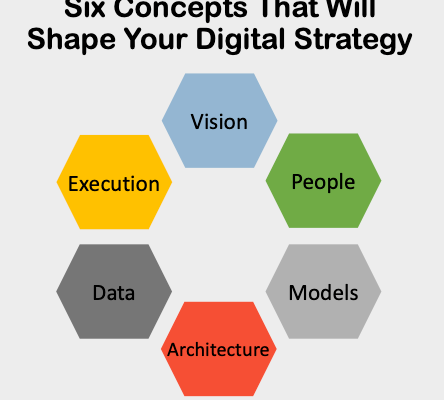
We recently published an updated digital strategy framework to help organizations start – or restart – their digital strategies.
Drawing on years of experience and collaboration with visionary leaders, this article explores the six essential concepts at the heart of the framework. These concepts—Vision, People, Models, Architecture, Data, and Execution—offer a clear and actionable foundation for organizations to achieve transformative success, even amid the inherent complexity of the implementation.

Vision: The Catalyst for Change
At the heart of any digital strategy lies a bold and innovative vision. This vision sets the organization on a new path—or accelerates its existing trajectory—by leveraging technology as a transformative force. It is the driver that redefines what’s possible, enabling businesses to challenge and disrupt the status quo.
It’s easy to dismiss Netflix, Amazon and Uber as “digital natives”, but they exemplify how a compelling vision can revolutionize industries. By reimagining entertainment, retail, and transportation, they disrupted decades—and in some cases centuries—of established norms, leaving competitors struggling to catch up.
Netflix executed three transformative strategy pivots over three decades, each reshaping its industry. First, in the late 90s, it delighted customer eliminating late fees and decimated Blockbuster with a DVD delivery subscription model. Ten years later, it revolutionized television with on-demand streaming, replacing traditional viewing habits. Finally, Netflix disrupted Hollywood itself by producing its own content —and established binge-watching, starting with House of Cards— in the process becoming a powerhouse studio and redefining entertainment forever.
A powerful vision doesn’t merely guide technology adoption; it redefines the organization’s mission and purpose in a digital-first world. It inspires teams to think beyond incremental improvements, pushing them to explore entirely new business models and customer experiences. The vision must be ambitious yet achievable, offering a clear direction that unites stakeholders around a common goal.
People: The Driving Force Behind Transformation
While technology is an enabler, people are the true rainmakers of digital innovation. From executives to frontline employees, the success of a digital strategy depends on the creativity, expertise, and commitment of the organization’s workforce.
Digital transformation starts at the top, with leadership embracing their role as champions of change. The CEO and executive team must drive the vision, ensuring alignment across all levels of the organization. However, transformation cannot stop at the leadership level. A digital strategy requires a cultural shift that permeates every corner of the organization, encouraging innovation, collaboration, and a willingness to challenge the status quo.
Empowering teams with the skills, tools, and autonomy to experiment and iterate is critical. As technology becomes increasingly commoditized, it is the ingenuity and determination of people that will differentiate successful organizations from their competitors.
Models: Unlocking Innovation Through Disruption
Identifying opportunities for innovation should be first step of any digital strategy. Yet, even creative business leaders sometimes struggle to envision what to transform, especially in traditional industries where long-standing practices and structures dominate.
This is where the Models component of the framework comes into play. By disassembling the business model, customer lifecycle, and operating frameworks, organizations can uncover hidden opportunities for disruption and growth.
This process of creative deconstruction allows leaders to think like startups—challenging established paradigms and imagining new ways to deliver value. Whether it’s rethinking customer engagement, rewiring supply chains, or introducing new pricing models, the possibilities are endless. The goal is to create structural and lasting competitive advantages that set the organization apart in a crowded marketplace.
Architecture: Building the Foundation for Innovation
Once new business models and processes are identified, the next step is to design a Digital Business Platform that brings them to life. The Architecture component of the framework focuses on building a modular, flexible, and scalable infrastructure that enables rapid innovation and adaptation. This requires more than just adopting state-of-the-art technology—it demands a fundamental rethinking of how processes and models are reflected in technology.
Digital leaders are not afraid to start with a blank slate, rebuilding their IT tech stacks and engineering practices to enable composable designs that align with operational capabilities. These architectures must enable seamless integration across legacy systems, cloud platforms, and emerging technologies.
None of the organizations we worked with over the past decade had architecture functions configured to drive digital innovation effectively from the outset. But with the right approach, they were able to build teams to support agile, customer-centric operations and enable transformative growth.
Data: The Nervous System of the Digital Enterprise
Data is the central nervous system that connects every moving part of the organization. To succeed, businesses must skillfully capture, manage, and analyze data. The goal is to create a unified data repository that removes silos, enables efficient execution and becomes a single source of truth that informs decision-making, uncovers insights, and drives innovation. This often requires overhauling existing data models, architectures, and governance practices.
The importance of data-driven decision-making has grown exponentially with advancements in analytics and AI. These technologies offer organizations unprecedented opportunities to understand customers, optimize operations, and uncover new pockets of growth.
However, building a data-driven culture takes time and effort. It requires robust governance structures, seamless integration of data assets, and a commitment to turning raw data into actionable intelligence.
Execution: Connecting Strategy to Results
The final concept—Execution—is where ambition meets reality. Execution is about connecting all the pieces of the digital strategy with agility, precision, and a relentless focus on value.
It starts with a solid strategic execution discipline, ensuring that initiatives and investments are aligned with business priorities and measured against clear performance targets. Organizations with well-established strategic execution practices have a significant advantage, as they can integrate digital initiatives into existing management processes and drive results more effectively.
Success requires a remarkable commitment to managerial hygiene: plan, execute, measure, adjust, and repeat. While this may sound straightforward, the graveyard of failed digital transformations proves that it’s anything but. According to McKinsey & Company, approximately 70% of digital transformation initiatives fail to achieve their intended goals. Leaders must prioritize alignment, accountability, and continuous learning, ensuring that the organization remains focused on implementing change and delivering meaningful outcomes. Digital innovation is a marathon, not a sprint.
The six concepts—Vision, People, Models, Architecture, Data, and Execution—are the foundation of a successful digital strategy. They offer a structured yet flexible framework that empowers organizations to navigate the complexities of digital innovation with confidence.
 Digital Transformation: A Framework